

Research question and scope
What can an outsourced coordinator observe when evidence may be stale, and what must remain an owner decision?
The desk analysis uses seller documents, asset licenses, renewal files, vendor records, and training evidence as bounded examples. It examines records a coordinator can preserve before an authorized client owner acts. It does not transfer approval authority or treat a workflow measure as a promise of business performance.
Methodology and sources
We applied four public sources to five hypothetical records. Philippine privacy principles informed purpose, proportionality, accuracy, and security; NIST audit guidance informed event and accountability records; CISA informed named-account safeguards; and PSA technical notes informed definitions and reference periods. Their application here is FilipinoOutsource.com analysis, not a requirement stated by those sources.
For each example we separated source facts, coordinator labels, owner decisions, and later outcomes. The proposed minimum record was: evidence type, source, captured date, stated validity date, policy version, material change event, last review, and decision owner. A second reading tested whether another reviewer could reconstruct the state without private explanation.
Finding and inference limits
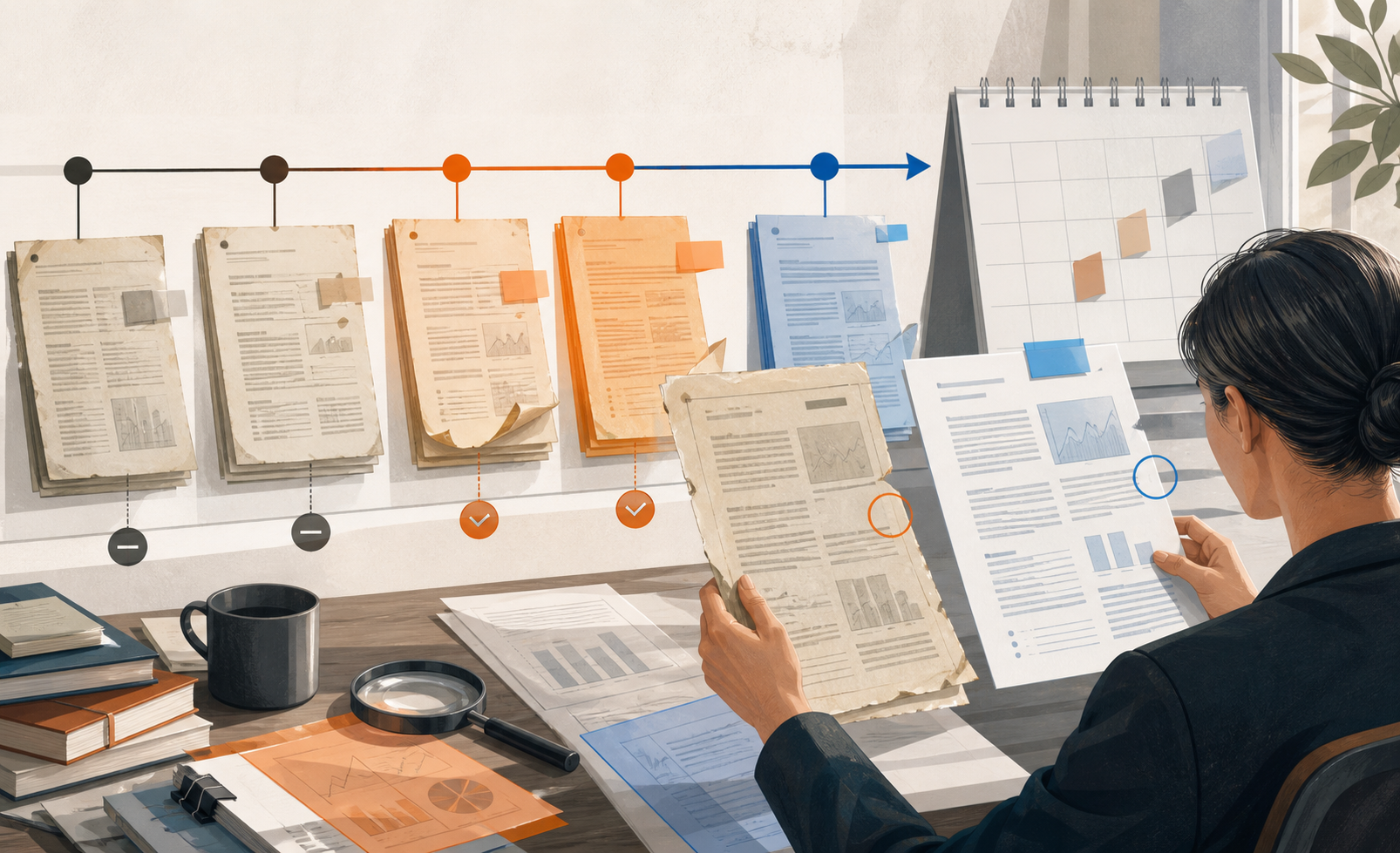
Freshness is a client-defined review trigger built from source dates, stated validity, and material change events,not age alone. Counts alone do not establish cause. Every figure needs an eligible population, observation period, exclusions, and the instruction version used during that period.
A coordinator may maintain the record and flag a client-defined condition. Decisions about staffing, access, policy, compliance, payment, or customer treatment remain with an authorized owner. The examples support process design, not judgments about a worker or provider.
Boundary case
A supplier document has no printed expiry date, but the legal entity changed after it was collected.
The defensible handoff preserves the original state and the later evidence, identifies what changed, and names the paused action. Replacing the first record would make the timeline look cleaner while removing review context.
Practical test routine
Start with five consecutive eligible items and one intentionally selected exception. Have a second reviewer locate the sources, apply the written definitions, identify the waiting owner, and reproduce the final state. Record disagreement instead of forcing agreement after the fact.
If reviewers use a category differently, revise its inclusion and exclusion examples, assign an effective date, and retain the superseded version. Do not recalculate earlier periods silently.
Limitations and conclusion
The cited sources do not specify freshness thresholds for these workflows; regulated and contractual requirements vary.
This research supports a narrow conclusion: freshness is a client-defined review trigger built from source dates, stated validity, and material change events,not age alone. A buyer should validate the proposed fields with its own systems, owners, data classes, and review obligations before scaling the routine.
Legal, accounting, clinical, employment, security, safety, and commercial determinations require the appropriate client owner or qualified professional. Nothing in this study is a country, provider, or worker comparison.
Methodology
Qualitative desk analysis applying official Philippine privacy guidance, NIST audit-control guidance, CISA account-security guidance, and PSA technical-note practices to five hypothetical evidence operations records. No provider, worker, customer, or business outcome was measured.
FAQ
Does this study set a performance benchmark?
No. It proposes observable fields and interpretation limits for a buyer to test in its own queue.
Can a coordinator make the underlying decision?
The coordinator can document and route evidence; the authorized client owner makes consequential decisions.
What is the smallest useful validation?
Review five eligible items and one exception against original sources with a second reviewer.
Sources and citation
- National Privacy Commission , Data Privacy Act of 2012privacy.gov.ph/data-privacy-act/
- NIST SP 800-53 Rev. 5 , Audit and Accountabilitycsrc.nist.gov/pubs/sp/800/53/r5/upd1/final
- CISA , Require Multifactor Authenticationwww.cisa.gov/secure-our-world/require-multifactor-authentication
- Philippine Statistics Authority , Technical Notespsa.gov.ph/statistics/technical-notes/165790