
Philippines hiring guide
How to plan Filipino board meeting action records support
Maintain approved actions and evidence while directors and officers retain governance decisions.
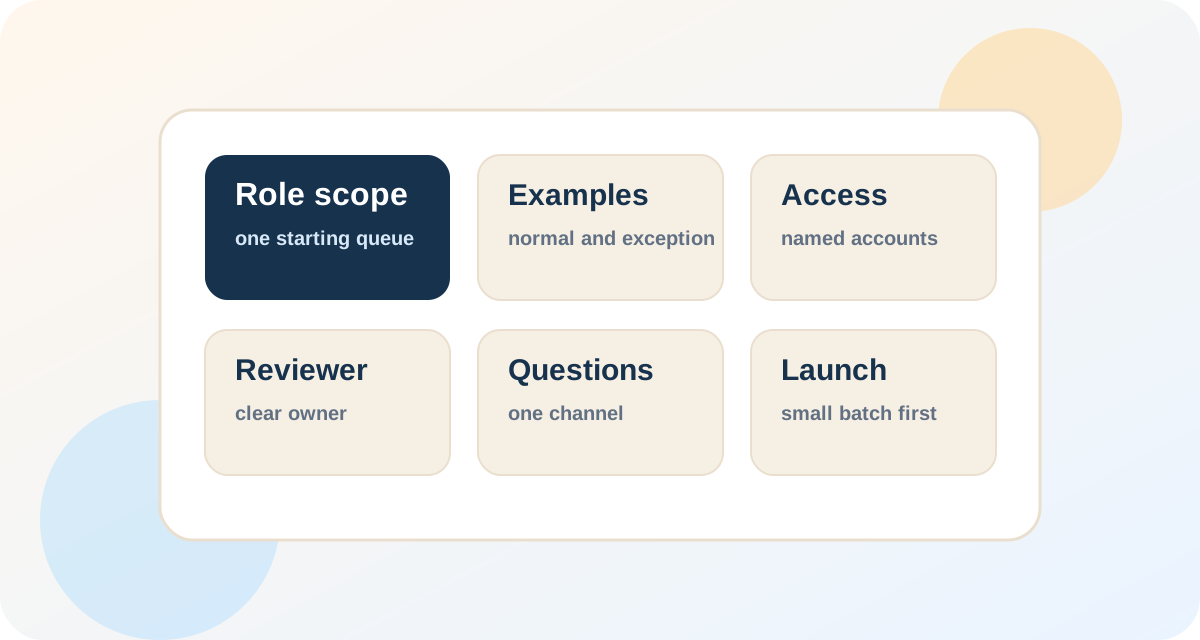
Short answer
Scope board meeting action records around a finite source packet, tested exceptions, limited access, and a named corporate secretary or governance owner.
What to settle first
- Define the source and finish point for board meeting action records.
- Preserve gaps and conflicting evidence.
- Keep consequential decisions with the corporate secretary or governance owner.
- Expand only after sampled work is reproducible.
Define the source packet
A board meeting action records queue begins with approved minutes, resolution identifier, exact action wording, named owner, due date, dependency, confidentiality level, and completion evidence. Preserve the source location and checking time for every consequential field.
Completeness means the packet is ready for review, not that the requested outcome is approved. The corporate secretary or governance owner remains visible beside every decision field.
Test conflicting evidence
Practice this stop case before launch: draft minutes name an action owner but the approved resolution names only a committee. Keep both sources, state the disagreement exactly, pause the consequential action, and route one focused question.
Also test one ordinary record and one incomplete record. Corrections should update the written example with an effective date rather than remain in private chat.
Limit access and preserve continuity
Grant named access only to systems required for board meeting action records. Record purpose, permission, approver, review date, and same-day removal steps.
A handoff names the last source checked, open question, current status, next owner, and approved substitute path. A substitute should never need to guess.
Review the source, not only the tracker
Sample the original evidence against the prepared packet. Classify returns as missing evidence, transcription error, stale source, source conflict, weak instruction, or judgment outside the role.
Track actions recorded, ownership gaps, due dates missing, evidence returns, and governance reviews. These are workflow signals, not guarantees of compliance, savings, accuracy, speed, revenue, or another business outcome.
Expand only after the lane is reproducible
Before increasing volume, ask a second reviewer to explain the intake, finish point, source hierarchy, stop case, access boundary, and corporate secretary or governance owner decision path.
If the explanation depends on memory, narrow the queue. New systems, data classes, audiences, or decisions require a fresh scope and access review.
Questions buyers ask
Q: What can the coordinator complete?
A: The coordinator can prepare and route the defined evidence packet using approved systems and examples.
Q: Who decides exceptions?
A: The corporate secretary or governance owner decides exceptions and approves any scope expansion.
Q: What should the first review include?
A: Review an ordinary record, an incomplete record, and the documented stop case.