
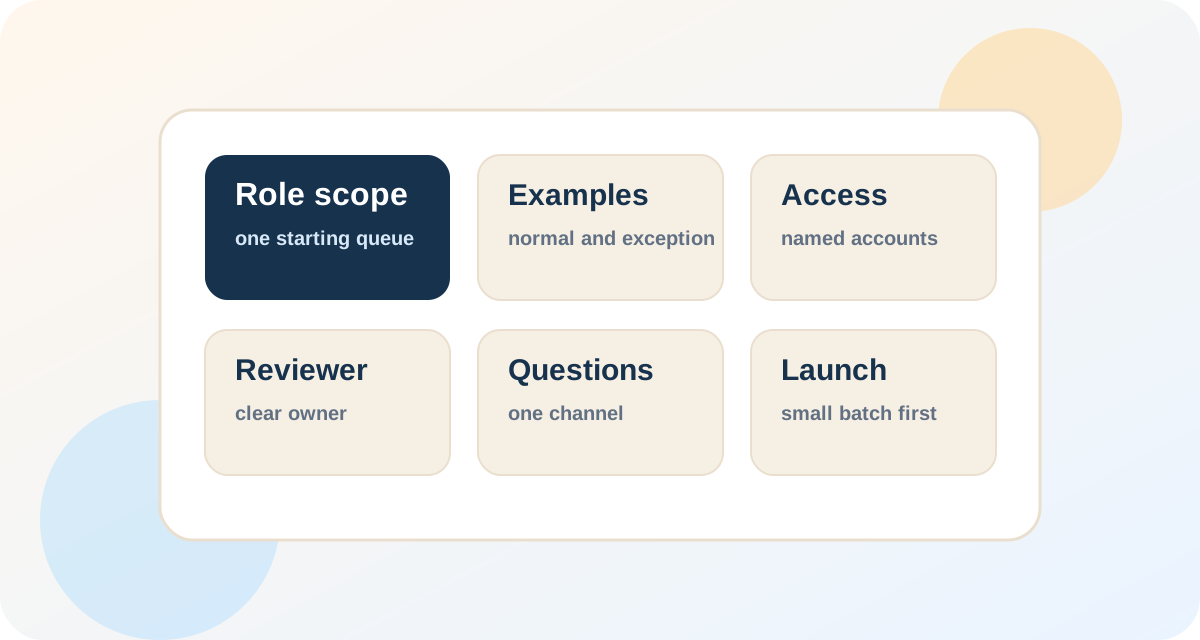
The buyer decision behind an eFAST support role
A company considering Philippines-based administrative support for SEC reporting should ask a narrower question than whether filing can be outsourced. The useful question is which preparation steps can be made repeatable without transferring corporate judgment or signatory authority. eFAST accepts annual financial statements, the General Information Sheet, and other covered reports from authorized filers. That makes the role operationally useful, but it also creates a boundary: assembling an approved packet is not the same act as deciding what the corporation must disclose.
This study treats one reporting event as a chain of evidence. The chain begins with the legal entity and covered period, moves through the approved form and attachments, records the authorized filer and submission event, and ends only when the resulting portal state has been reviewed. Each link needs a source, version, owner, timestamp, and status. A generic task marked filed hides the very distinctions that matter when a document is reverted, uploaded under the wrong entity, or accepted with the wrong period.
For a buyer, the staffing implication is concrete. A coordinator can maintain a calendar, request approved inputs, run format checks, name files, stage documents, record portal responses, and chase an assigned correction. Corporate officers, counsel, accountants, and authorized signatories retain responsibility for report selection, substantive accuracy, certification, approval, and any conclusion about legal compliance. Access should be granted only after those responsibilities are written into the workflow.
What the SEC sources establish
The SEC eFAST FAQ describes the service as an online submission tool for Annual Financial Statements, General Information Sheets, and other covered annual reports. It also identifies authorized filers as the people who submit through registered accounts. The current user guide adds a crucial control point: the authorized filer and document signatories are responsible for accuracy and completeness, and the required file format depends on the report. Those statements support a preparation role, but they do not authorize a coordinator to certify content.
The SEC reportorial-requirements page separates document types and due-date rules. It also reflects newer routing, including the use of HARBOR for beneficial-ownership declarations and the 2026 GIS version. This matters because an old checklist can be internally consistent and still send the wrong document to the wrong system. A durable desk procedure therefore stores the controlling SEC page, date checked, entity classification supplied by the owner, covered period, selected report, due-date decision, and destination decision.
The portal guidance also distinguishes a submitted record from an accepted one and publishes material about avoiding reversion. Operational analysis follows from that distinction: the coordinator should capture the upload identifier and response without asserting acceptance, then return later under an approved schedule to capture the actual status. If the system reports a reversion or mismatch, the worker preserves the message verbatim and routes it; they do not silently alter a signed document to make the portal accept it.
Designing the filing packet
Start with a cover record containing exact corporate name, SEC registration number, report type, reporting period, fiscal year end, approved due date, filing channel, source links, accountable officer, preparer, reviewer, authorized filer, and signatory set. Reference protected documents by controlled location instead of duplicating them into open tickets. A version label should change whenever an approved field, signature page, attachment, or conversion output changes. The final upload candidate must be reproducible from the recorded inputs.
Run mechanical checks separately from substantive review. Mechanical checks can test file type, size, naming, page count, legibility, orientation, presence of required pages, period labels, and consistency between the cover record and visible document identifiers. Substantive review asks whether facts, classifications, figures, disclosures, signatures, and certifications are correct. The coordinator may report a discrepancy found by comparison, but the responsible officer or professional decides the correction and approves the replacement.
Record five states: requested, owner-approved, staged, submitted, and portal-resolved. A packet is not ready because every file exists; it is ready when the designated owner approves the exact versions and the authorized filer is identified. It is not submitted because a browser upload reached one hundred percent; it is submitted when the system returns the relevant transaction evidence. It is not resolved because an email arrived; it is resolved when the reviewed portal status and any required correction are attached to the record.
Boundary scenario: a last-minute GIS change
Assume a GIS packet has signatures and appears ready. Hours before filing, the corporate secretary sends a new officer address in chat, while the approved source record still shows the earlier address. At the same time, the portal account lists a former employee as active filer. The coordinator should stop the affected steps, preserve both versions, ask the corporate owner which record controls, and require the filer-access owner to resolve account authority. The worker should not edit a signed form from chat or submit through the former employee.
A focused escalation names the entity, period, form version, disputed field, competing sources, existing signatures, deadline, portal-account issue, action withheld, and requested decision. The answer must identify the approved value, whether a new document and signature are required, who may file, and whether the deadline plan changes. This is more useful than forwarding a long thread because it lets the owner see the decision surface without implying that the coordinator has already chosen.
After resolution, the history remains. Do not overwrite the superseded packet or delete the access anomaly. Link the owner decision, regenerated file, new approval, account change, submission response, and final portal status. That evidence supports later review of what happened and helps improve the next cycle. It does not prove the report was legally sufficient; it proves that the administrative handoff followed the authorized decision.
A bounded test before scaling
Test the workflow on three completed filings and two exception cases, selected consecutively rather than chosen for cleanliness. For each, trace the calendar decision to the SEC source, source records to the approved document, approved document to the exact uploaded hash, authorized filer to the submission event, and portal response to the final owner review. Record exclusions before computing any completion measure. One missing evidence link is an exception even when the portal eventually shows accepted.
Review failure modes qualitatively. Look for corporate details copied from an earlier year, wrong period labels, unapproved changes after signature, unreadable scans, stale filer access, uploads to the wrong entity, response emails without portal confirmation, and reverted documents closed as complete. Measure the age of unresolved decisions separately from preparation time. That prevents an approval delay from being blamed on the coordinator and prevents a fast upload from being celebrated when its underlying packet was wrong.
Repeat the test whenever the SEC changes a form, destination, authentication method, report list, or portal behavior; whenever the corporation changes officers, fiscal year, signatories, or service providers; and whenever a filing produces an unexpected response. Past acceptance is evidence about one packet under one configuration. It is not permission to reuse an old answer without reviewing current requirements.
Method limits and accountable ownership
This is a qualitative desk review, not a filing opinion or test of a real corporation. It does not determine whether an entity must file, which form applies, when a deadline falls, whether a document is complete, whether a signature is valid, or what a portal status means for legal compliance. Those conclusions require current facts and the corporation’s authorized professionals. The sources were checked on October 2, 2026 and can change after that date.
The narrow conclusion is operational: eFAST support is a reasonable administrative role when the buyer separates source collection, document approval, filer authority, submission, portal resolution, and correction evidence. A good role brief names the officer who owns report selection, the professional who owns substantive figures or disclosures, the person who approves the final document, the filer who performs submission, and the backup who handles exceptions.
Buyers should reject a proposal that promises to take care of SEC compliance without naming these decisions. They should prefer a workflow that makes uncertainty visible, limits credentials, preserves exact versions, and treats a stop for missing authority as correct performance. That design gives an outsourced coordinator useful work while keeping corporate accountability with the people who actually hold it.
Turn the filing calendar into a controlled queue
Define document sources, approval owners, filer access, portal evidence, and reversion escalation before assigning SEC administration.
Review administrative supporteFAST evidence gates
| Gate | Evidence | Owner decision |
|---|---|---|
| Scope | entity, report, period, current SEC source | what must be filed |
| Packet | approved files, hashes, signatories | content is authorized |
| Submission | authorized filer, transaction response | release to portal |
| Resolution | portal status, reversion message | correction or closure |
Methodology
Qualitative desk review of current SEC eFAST instructions, user guidance, and reportorial-requirements pages checked October 2, 2026. The method separated published facts from operating inferences and tested one hypothetical exception. No company account, filing, deadline, document, or acceptance result was examined.
FAQ
Can a coordinator sign or certify the report?
No. Signing, certification, substantive approval, and filing authority stay with the designated corporate owners.
Does an upload receipt prove acceptance?
No. Preserve the receipt and separately review the portal disposition and any reversion.
Sources and citation
- SEC eFAST FAQ (Accessed October 2, 2026)efast.sec.gov.ph/faqs
- SEC eFAST User Guide (Accessed October 2, 2026)efast.sec.gov.ph/user/static/media/user_guide_022825.2d5ac2ad.pdf
- SEC reportorial requirements for corporations with primary licenses (Accessed October 2, 2026)www.sec.gov.ph/reportorial-requirements/corporations-with-primary-licenses/