
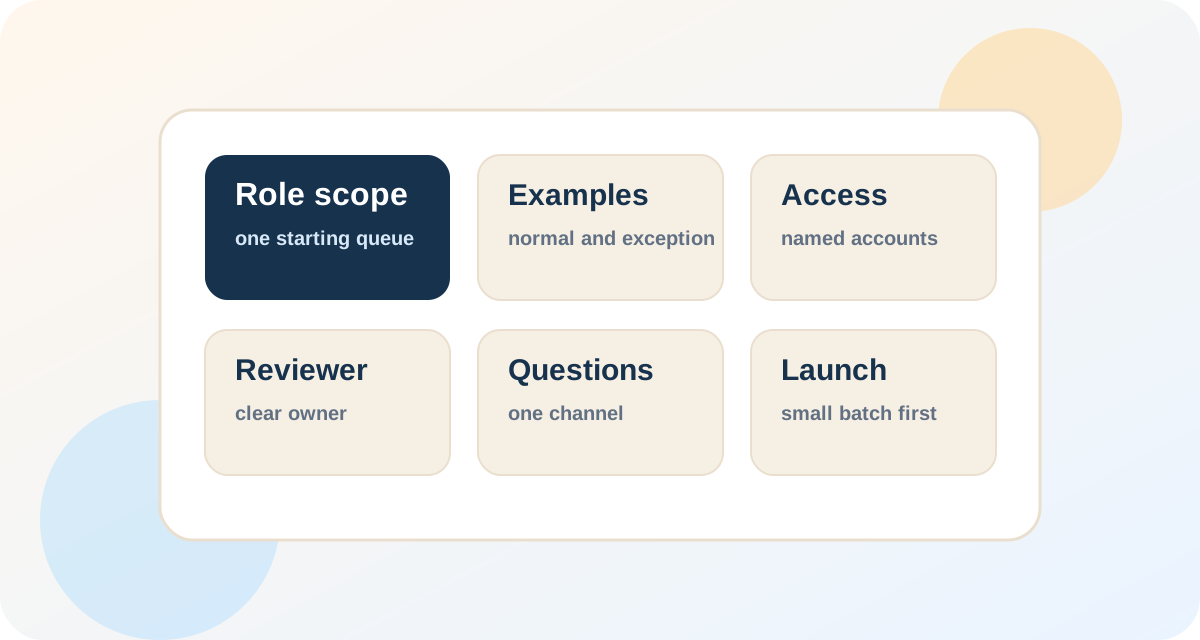
The launch question comes before the content queue
The DTI Fair Trade Enforcement Bureau explains that its Sales Promotion Division regulates promotional campaigns through permits. Its published elements include promotion of a brand, product, or service; an inducement involving gain or a chance of winning; a limited period; public communication; and consumer participants. DTI also provides online application and permit-search routes. These sources show why campaign administration cannot begin with a social post and add governance later.
A Philippines-based marketing operations coordinator can collect owner-approved mechanics, maintain an asset register, prepare application evidence, compare creative with approved terms, record permit references, schedule approved materials, and preserve fulfillment records. The worker should not decide permit applicability, draft legal terms, substantiate a special claim, select winners outside approved mechanics, change an offer, or represent that a campaign complies.
The buyer decision is whether the campaign process gives that coordinator authoritative inputs. If launch dates, audience, entry method, prize, geographic scope, channels, and terms shift in separate chats, no administrative checklist can produce a reliable public campaign. The evidence pack must establish one approved version and make every later change visible.
Describe mechanics before asking for assets
Create a campaign identity with legal sponsor, participating brands, products or services, objective, campaign type proposed by the owner, audience, geography, eligibility, start and end, entry steps, purchase condition if any, prize or benefit, quantity, value supplied by the owner, selection method, draw or determination date, notification, claim process, fulfillment, disqualification terms, complaint route, channels, agencies, data collected, privacy notice, and accountable approvers.
Separate facts from classification. The coordinator may flag that the proposal includes a limited period, public advertising, consumer participation, and a promised gain because those are stated mechanics. The responsible legal or compliance owner decides whether DTI permit rules apply, which office or system is appropriate, what lead time controls, and what documents and wording are required. Record that decision with its source and conditions.
Give mechanics a version and hash. Terms, application forms, creative briefs, landing-page copy, scripts, winner materials, and fulfillment records should reference that version. If a prize, date, channel, entry step, or geographic scope changes, reopen review rather than editing one asset. The core risk is divergence: a banner can be visually correct yet promise something different from the approved terms.
Build permit and publication gates
Use distinct states: concept, classification pending, application prepared, owner approved, submitted, permit decision recorded, assets reconciled, launch approved, live monitoring, winner or benefit fulfillment, and closed. A submission acknowledgement is not a permit. A permit reference is not proof that every asset matches. A scheduled post is not live evidence. Keeping the states separate prevents one successful step from closing the entire campaign.
Before release, compare every public asset with the approved mechanic fields that it expresses: sponsor identity, offer, eligibility, period, entry route, prize, quantities, claim limits, required permit reference, material conditions, and links. Check the destination page and mobile rendering, not only the design file. The campaign owner decides whether wording is complete and whether a claim is substantiated; the coordinator records the approval and deployed asset hash.
After publication, capture final URL or placement, first observed time, visible mechanics, linked terms, permit reference where required, image response, and responsible monitor. If an asset is wrong, preserve it, stop or correct under the owner’s instruction, and record the period affected. Silent replacement removes evidence needed to answer consumer questions and learn why the mismatch escaped review.
Boundary case: a prize changes after approval
Assume a campaign was prepared around ten identical vouchers. Inventory changes one day before launch, and the marketing lead proposes five larger vouchers with the same total value. Creative has already been approved and a permit decision refers to the earlier mechanics. Equal total value does not make the public promise, odds, winner count, or approved campaign identical. The coordinator should stop scheduling and route the proposed change.
The escalation should identify the campaign, mechanics version, permit or classification decision, exact old and proposed prizes, quantity, winner impact, assets affected, planned start, vendors, data flows, and deadline. Ask the campaign and legal owners whether new approval, amended materials, authority contact, or schedule change is required. Do not revise fine print while leaving headline creative unchanged, and do not treat verbal approval as a complete change record.
If the change is authorized, regenerate every affected artifact, obtain the required approvals, record new hashes, and verify scheduling. If it is rejected, confirm that old mechanics remain feasible or pause the campaign. This example gives buyers a specific reader outcome: the coordinator is not a permit expert, but a version-controlled workflow can stop a seemingly minor operational change from becoming a different public offer.
Follow the campaign through fulfillment
The evidence pack should not end at launch. Track eligible entries according to approved mechanics, restricted access to participant data, selection input and method, witnessed or system evidence required by the owner, winner validation, notification attempts, claim status, fulfillment, unclaimed outcomes, consumer questions, complaints, and final owner closeout. The coordinator executes documented steps; the authorized owner decides disputes and exceptions.
Review five assets across different channels and five participant or fulfillment records selected consecutively. Trace each asset to the mechanics version and approval. Trace each selected record through eligibility evidence, determination, communication, and fulfillment without collecting unnecessary personal data. State exclusions and access limits. The sample tests workflow consistency, not fairness of the entire campaign or legal compliance.
Useful measures include assets reconciled before launch, late changes, publication mismatches, participant records awaiting owner decision, failed notification, fulfillment aging, complaints, and unresolved closeout tasks. Do not use engagement, entries, or redemption as proof of compliance or consumer satisfaction. Those measures answer different business questions and can distract from whether the offer was executed as approved.
Sources, uncertainty, and role boundary
DTI public guidance checked October 2, 2026 describes the Sales Promotion Division, common promotion elements, online application through iRegIS for relevant campaigns, permit search, and consumer-protection context. The Consumer Act also addresses permits and substantiation of special claims. The exact classification, jurisdiction, procedure, documents, timing, exclusions, and campaign duties depend on current rules and actual mechanics.
This article does not classify a campaign, secure a permit, interpret the Consumer Act, review advertising, validate a draw, decide a complaint, or provide legal advice. No live application, campaign, participant dataset, winner selection, or fulfillment was tested. The hypothetical case is invented. Buyers must use current DTI instructions and qualified Philippine legal or compliance advisers for consequential decisions.
The limited conclusion is strong enough for staffing: campaign administration is delegable when the company supplies approved mechanics, a permit decision, controlled assets, publication authority, privacy rules, fulfillment instructions, and named exception owners. The coordinator’s value lies in keeping those pieces aligned. A proposal that transfers campaign compliance to an assistant without those decisions is not a complete operating model.
Build campaign controls before opening the content queue
Define mechanics, permit decisions, asset versions, publication approval, participant-data access, fulfillment, and exception owners.
Review digital marketing supportPromotion evidence lifecycle
| Stage | Coordinator evidence | Owner authority |
|---|---|---|
| Design | mechanics version and asset inventory | classification and terms |
| Permit | application and official response | interpretation and approval |
| Launch | approved asset hashes and live checks | release decision |
| Closeout | selection, fulfillment, complaints | exceptions and closure |
Methodology
Qualitative review of DTI-FTEB Sales Promotion Division guidance, sales-promotion FAQs, and the Consumer Act text checked October 2, 2026. The analysis mapped campaign mechanics to version and publication evidence and tested a changed-prize scenario. No campaign or permit was assessed.
FAQ
Can a coordinator decide whether a permit is required?
No. They can organize the facts and evidence, but the qualified owner must make and document that decision.
Does a permit reference approve every creative asset?
No. Each released asset still needs comparison with approved mechanics and owner authorization.
Sources and citation
- DTI-FTEB Sales Promotion Division (Accessed October 2, 2026)fairtrade.dti.gov.ph/about/business-regulations/sales-promotion-division/
- DTI-FTEB sales promotion FAQs (Accessed October 2, 2026)fairtrade.dti.gov.ph/stripped-sales-promo-faq/
- Consumer Act of the Philippines text hosted by DTI (Accessed October 2, 2026)standardsph.dti.gov.ph/upload/upload/download?file=e4f8n8H2Sa3uc20230927651374470a596.pdf&path=storage%2Fuploads%2Fsdac%2Fpns%2Flaws_issuances%2F