
The decision this research supports
What evidence should a buyer assemble before an accountable privacy owner decides whether and how to assess a proposed outsourced workflow?
This desk study is for buyers designing Philippines-based support. It examines privacy-impact-assessment readiness as an operating decision, not as a promise about a provider, worker, product, or legal result. The aim is to make purpose, authority, evidence, handoffs, and unresolved questions visible before volume or access expands.
Cited authorities establish rules or guidance only within their scope. The workflow design in this article is FilipinoOutsource.com analysis. The publishers have not reviewed or endorsed the design, and the analysis must be tested against the buyer’s actual contracts, systems, data, locations, and accountable owners.
Facts, analysis, inference, and uncertainty are deliberately separated. Source propositions appear in the next section. Recommended fields and controls are operational inferences. The boundary case is hypothetical. Limitations explain what this desk review cannot decide.
What the primary sources establish
1. NPC guidance describes a privacy impact assessment as a process for identifying potential privacy effects of a process, system, program, software, device, or other initiative that processes personal information and for treating identified risk. 2. The NPC says assessment begins early enough to influence an initiative and continues through and after deployment; it is not a one-time document completed after design choices are fixed. 3. Current NPC security guidance identifies privacy impact assessment and a privacy management program among the general obligations of controllers and processors and connects security to access, storage, continuity, training, and incident management. 4. An outsourcing proposal changes the factual map when another organization, worker population, location, account, device, integration, or support channel can receive or influence personal data, even if the business purpose appears unchanged.
The 3 primary sources were checked on September 24, 2026. A checked date establishes when the research team reviewed the public material; it does not guarantee that a page, rule, register, interpretation, or organization-specific fact will remain unchanged. The accountable owner should recheck the authority before a consequential decision.
Do not collapse a source statement into a broader commercial claim. A rule about controller accountability does not prove that a vendor is secure. A registration record does not prove service quality. A policy does not prove implementation. A completed ticket does not prove that the requester had authority or that the resulting action was accurate.
Local facts often decide the hard question: which entity contracted, who employs the worker, who determines purpose, which fields were visible, which account performed the action, where a copy remained, and who approved the exception. Those facts need contemporaneous evidence rather than confident language.
A minimum operating record
1. Screen the initiative before access: purpose, accountable controller, processor and subprocessor roles, people affected, data elements, sensitive fields, sources, systems, locations, transfers, automated steps, decisions, recipients, retention, deletion, and incident route. 2. Map the current state and proposed state separately. Record which party determines purpose and means, which party follows instructions, where data is copied or synchronized, who can export it, what audit evidence exists, and what happens during support, failure, and termination. 3. Give the privacy owner concrete design choices rather than a generic approval request: narrower fields, redaction, synthetic training data, browser-only access, disabled exports, named accounts, shorter retention, separated duties, additional review, or no outsourcing for the high-risk step. 4. Maintain a decision record with assessor, stakeholders consulted, risks, affected rights, likelihood and impact basis, chosen measures, residual risk owner, conditions, implementation evidence, review trigger, and closure. Reopen it when facts change rather than copying the former conclusion.
Separate proposal, approval, implementation, verification, and correction. A proposal records what someone wants to happen. Approval records who had authority and any conditions. Implementation records what actually changed. Verification compares the result with the decision. Correction preserves what was wrong, who fixed it, why, and which downstream records or people were affected.
A stable record should link to evidence without duplicating sensitive content into less controlled tools. Use identifiers for the case, instruction version, contract, system, account, source, decision, and output. Apply access and retention rules to the evidence itself; an audit trail can create a second exposure when it indiscriminately copies personal data.
Record negative evidence carefully. “No export found” should name the logs and period checked. “No new recipient” should identify the system boundary reviewed. “No sensitive field used” should state the field list and sample. An absence observed in one place and time is not a permanent claim about the entire organization.
Boundary case and escalation
A buyer wants a remote coordinator to clean a customer spreadsheet. During scoping, the file is found to contain health notes, identity documents, children’s information, free-text complaints, and links to a new AI enrichment tool. “Spreadsheet cleanup” no longer describes the actual processing.
The first safe move is to preserve the request, identify the current instruction, and pause only the action that exceeds it. The support worker should state the mismatch in concrete terms and ask one question of a named owner. Broad messages such as “please advise” delay decisions and tempt others to infer missing context.
An escalation should include the case identifier, observed facts, source evidence, relevant instruction and version, data or people affected, action completed, action not completed, deadline, immediate risk, receiving owner, and requested decision. Sensitive attachments should remain in an approved repository with controlled access instead of being copied into group chat.
The owner may reject the request, narrow it, require new evidence, add safeguards, obtain specialist review, approve a limited test, or authorize the change with conditions. The response must be captured with author, scope, effective time, and expiry. Approval for one case, dataset, tool, audience, or period should not silently become a standing rule.
After action, a different check should compare the real result with the decision. Verify access, affected records, recipients, output, logs, retained copies, notices, and cleanup. If the system cannot produce enough evidence, record the gap and narrow the workflow instead of treating lack of visibility as proof that nothing went wrong.
Access, handoff, correction, and exit
Access should follow the required output. Use named accounts, least practical privileges, approved devices and storage, strong authentication, and separate authorization for exports, settings, mass changes, payments, publication, or deletion. Record the approver, grant time, review date, and removal trigger.
A cross-time-zone handoff needs item status, evidence checked, completed action, paused action, deadline, affected customer or system, and receiving owner. “Done” is not an adequate state when an authorization, exception, correction, communication, or release remains outstanding. The next shift must be able to reconstruct the issue from controlled records.
Correction history should preserve the prior value, corrected value, source for each, actor, reason, event time, and downstream effect. Silent overwrites can conceal which state drove an earlier decision. Where notification or remediation may be needed, the qualified owner decides it and the operations role records execution evidence.
Exit is part of design. Decide how accounts, sessions, tokens, shared links, local files, synchronized folders, exports, backups, printed records, integrations, and subprocessor access are removed or transferred. Obtain observable evidence and record unresolved residual copies rather than accepting a generic statement that access was turned off.
How to test before scaling
Begin with five consecutive eligible cases after a declared start point. Do not select polished examples after seeing the result. Retain incomplete, paused, corrected, and disputed cases when they naturally occur, and state why any case is excluded. This can test whether an instruction is usable; it cannot establish a provider-wide rate.
For each case, ask whether purpose was identifiable, inputs were necessary, source evidence was preserved, the current instruction was used, access stayed within scope, exceptions stopped, the owner received an answerable question, and the final state matched the recorded decision. Preserve reviewer disagreement as evidence about the rule.
Useful measures are descriptive: eligible cases, missing sources, identity conflicts, unapproved systems, paused actions, owner response time, corrections, overrides, removal failures, and unresolved exceptions. Each count needs a denominator, period, inclusion rule, and evidence source. None alone proves compliance, safety, fairness, productivity, or worker quality.
Repeat the review after a change in law or guidance, purpose, party, contract, data category, system, integration, feature, location, schedule, reviewer, consequence, retention, or repeated exception. Earlier evidence describes an earlier state; it is not a permanent certification of the process.
Limits and accountable ownership
The required assessment depth, consultation, lawful basis, transfer safeguards, security controls, residual-risk acceptance, and whether processing should proceed depend on the actual parties, data, technology, consequences, and applicable laws. A completed template does not itself establish compliance or safety.
Support staff can retrieve approved evidence, enter defined fields, apply an administrative status under a written rule, prepare a comparison, and route a focused exception. They should not be assigned decisions about legal interpretation, rights, employment status, security risk, regulatory reporting, or other consequential matters outside written authority.
The accountable controller, employer, client manager, data protection officer, security lead, counsel, HR owner, finance owner, or other qualified professional must decide questions within their remit. Titles vary, but the operating record should name a person or controlled role and a backup rather than an unspecified department.
Workers need a protected stop path. Throughput pressure, urgency, a senior requester, or a familiar-looking precedent does not replace missing authority. A correct stop should be evaluated as correct work when the instruction requires it, and recurring stops should prompt the owner to clarify the rule.
The narrow conclusion is that privacy-impact-assessment readiness becomes more reviewable when purpose, source, data, parties, systems, authority, action, verification, correction, and exit evidence remain connected. Documentation supports accountability; it does not make an underlying activity lawful, secure, fair, or effective by itself.
A buyer implementation sequence
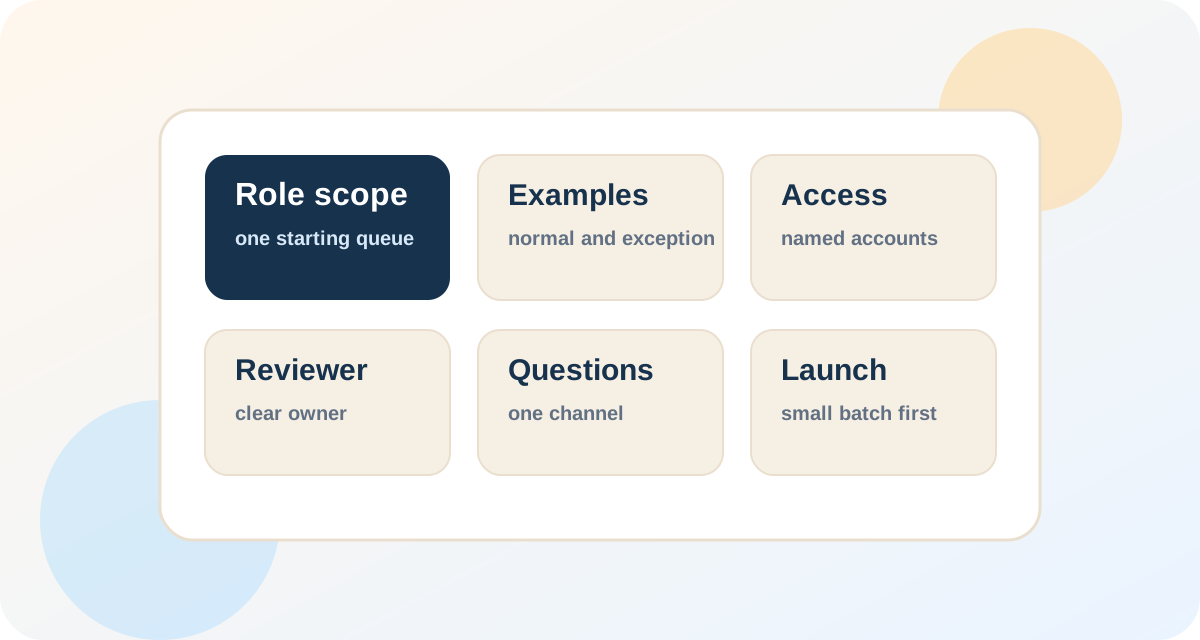
First, describe one finished output in plain language. Second, identify its authoritative inputs and minimum necessary data. Third, map every party, system, account, location, and copy involved. Fourth, name the decisions retained by the client and the specialist owners who receive exceptions. Fifth, test with redacted or synthetic examples before granting live access.
Next, run the bounded consecutive sample and inspect exceptions more closely than volume. Confirm that workers can find the current instruction, that reviewers can reproduce status from source evidence, and that owner responses answer the precise question asked. Where ambiguity repeats, revise the instruction and examples before increasing volume.
Then align commercial documents with operations. Check that the actual provider, employing or contracting entity, purpose, service, data flow, access model, subprocessor path, security commitments, incident route, rights support, retention, deletion, and exit evidence match what daily tools and managers require.
Finally, keep a dated decision register showing what changed, why, sources reviewed, uncertainty, approver, conditions, implementation evidence, later corrections, review trigger, and exit result. This creates a controlled learning cycle while leaving legal and professional judgments with the people accountable for them.
Map the data before staffing the task
Use the data processing support guide to identify minimum fields, systems, access levels, reviewers, exceptions, and removal evidence for the proposed role.
Review data processing supportMethodology
Qualitative desk review of 3 primary Philippine government sources, checked September 24, 2026. The method separated explicit source propositions from FilipinoOutsource.com operating analysis, applied the analysis to one hypothetical boundary case, and defined a five-case consecutive review. No provider, worker, client, personal data, production system, price, performance result, or legal outcome was tested. The method cannot establish prevalence, causation, compliance, security, or service quality.
FAQ
Is this legal, privacy, employment, security, or tax advice?
No. It is a buyer-side research and workflow framework. Qualified advisers and accountable owners must decide how current rules apply to real facts.
Does a five-case review prove quality or compliance?
No. It tests whether the current written instruction is usable on a bounded set and exposes exclusions, uncertainty, and disagreement.
What may the support role own?
Approved evidence gathering, defined administrative fields, status preparation, correction records, and focused escalation—not consequential decisions outside written authority.
When should the record be reopened?
When purpose, source, data, party, contract, system, tool, location, reviewer, consequence, law, or retention practice changes.
Sources and citation
- National Privacy Commission — Five Pillars: Privacy Impact Assessment (Accessed September 24, 2026)privacy.gov.ph/5-pillars-of-compliance-2/
- National Privacy Commission — Guidelines on Privacy Impact Assessment, Advisory 2017-03 (Accessed September 24, 2026)www.privacy.gov.ph/wp-content/uploads/2022/01/NPC_AdvisoryNo.2017-03.pdf
- National Privacy Commission — Circular 2023-06 security requirements overview (Accessed September 24, 2026)privacy.gov.ph/npc-issues-circulars-to-strengthen-personal-data-protection-in-ph/