
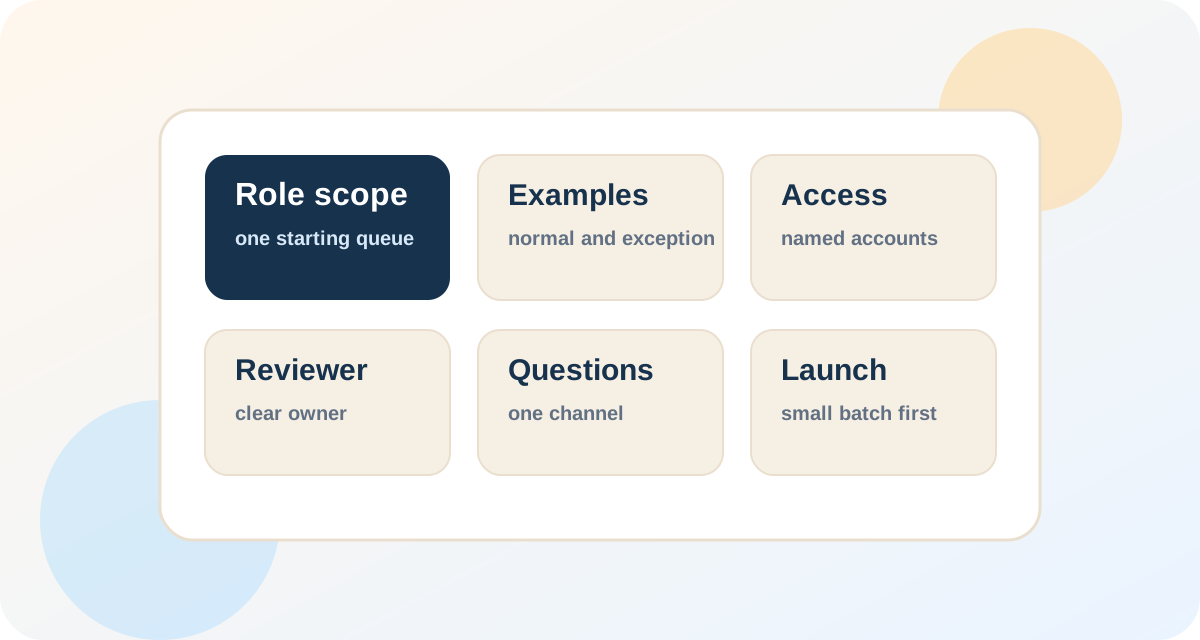
The decision this PhilHealth remittance handoff study can support
How can a Philippines-based payroll support role prepare PhilHealth reporting evidence while the employer retains classification, contribution, payment, and correction decisions?
This article is a desk review for a buyer designing a Philippines-based support role. It evaluates the evidence needed to prepare, route, verify, and correct PhilHealth remittance handoff; it does not certify a provider, decide an employer duty, or promise a result. Facts attributed to public authorities are separated below from FilipinoOutsource.com operating analysis, the hypothetical boundary case, and unresolved questions.
The useful unit of review is one real case with a declared start point and controlled source version. Totals, dashboard states, certificates, and tickets are supporting signals, not substitutes for person-level or transaction-level evidence. The buyer should name the person authorized to decide exceptions before access is granted, then preserve both the decision and proof of execution.
Primary-source findings for PhilHealth remittance handoff
PhilHealth instructs employers to deduct the employee share, add the employer share, remit through accredited channels by the applicable schedule, and use the Electronic Premium Remittance System for payment and reporting procedures. For PhilHealth remittance handoff, that proposition changes the evidence design in a specific way: the 1th source claim must be linked to the employer record, covered period, system event, and named decision owner that make it relevant. A reviewer should be able to distinguish the authority's statement from a payroll team's interpretation and from the result observed in an individual account. If those layers are blended, a successful transaction can conceal an omitted person, an old roster, or an unresolved posting difference.
PhilHealth describes EPRS as a web application for employee information, premium remittance, and remittance reporting; access to that system therefore combines personal-data handling with financially consequential workflow steps. For PhilHealth remittance handoff, that proposition changes the evidence design in a specific way: the 2th source claim must be linked to the employer record, covered period, system event, and named decision owner that make it relevant. A reviewer should be able to distinguish the authority's statement from a payroll team's interpretation and from the result observed in an individual account. If those layers are blended, a successful transaction can conceal an omitted person, an old roster, or an unresolved posting difference.
The official employer page separates registration, amendment of employer data, payment and reporting, non-remitting or non-reporting status, and benefit-availment support, showing that one payment confirmation does not settle every employer or member record. For PhilHealth remittance handoff, that proposition changes the evidence design in a specific way: the 3th source claim must be linked to the employer record, covered period, system event, and named decision owner that make it relevant. A reviewer should be able to distinguish the authority's statement from a payroll team's interpretation and from the result observed in an individual account. If those layers are blended, a successful transaction can conceal an omitted person, an old roster, or an unresolved posting difference.
A support worker can reconcile approved payroll inputs and preserve acknowledgements, but should not determine member status, contribution treatment, arrears, penalties, benefits eligibility, or whether an employer has discharged a legal duty. For PhilHealth remittance handoff, that proposition changes the evidence design in a specific way: the 4th source claim must be linked to the employer record, covered period, system event, and named decision owner that make it relevant. A reviewer should be able to distinguish the authority's statement from a payroll team's interpretation and from the result observed in an individual account. If those layers are blended, a successful transaction can conceal an omitted person, an old roster, or an unresolved posting difference.
Operating controls for PhilHealth remittance handoff
Create a period packet linking the employer number, approved payroll version, employee roster version, membership identifiers in a protected system, compensation basis supplied by payroll, employee and employer shares, total, exclusions, preparer, reviewer, and cutoff. Control 1 should be tested against a late roster change, a rejected EPRS action, and a payment that posts only in part. The test is successful only when the packet shows which people were included, which source version was approved, what the system accepted, and who owns every exception. A generic completed status is inadequate because preparation, remittance, reporting, and member posting can reach different states at different times.
Record EPRS stages separately: roster update, statement preparation, approval, payment instruction, authorized payment, transaction reference, receipt, remittance-report submission, system acknowledgement, member posting check, and unresolved exception. Control 2 should be tested against a late roster change, a rejected EPRS action, and a payment that posts only in part. The test is successful only when the packet shows which people were included, which source version was approved, what the system accepted, and who owns every exception. A generic completed status is inadequate because preparation, remittance, reporting, and member posting can reach different states at different times.
Route new hires, separations, absent or conflicting identifiers, retroactive adjustments, duplicate lines, contribution-table questions, rejected transactions, total mismatches, late items, and employee disputes to the named payroll or benefits owner. Control 3 should be tested against a late roster change, a rejected EPRS action, and a payment that posts only in part. The test is successful only when the packet shows which people were included, which source version was approved, what the system accepted, and who owns every exception. A generic completed status is inadequate because preparation, remittance, reporting, and member posting can reach different states at different times.
Reconcile the approved list to the payment and later posting evidence. Preserve the original line, correction request, owner decision, resubmission, result, affected period, and employee communication without copying the full roster into an open ticket. Control 4 should be tested against a late roster change, a rejected EPRS action, and a payment that posts only in part. The test is successful only when the packet shows which people were included, which source version was approved, what the system accepted, and who owns every exception. A generic completed status is inadequate because preparation, remittance, reporting, and member posting can reach different states at different times.
Boundary case: where administrative support must stop
An employer payment succeeds, but two employees were omitted after a late roster change and a third line carries an identifier that belongs to a former worker. The coordinator may isolate and document each mismatch; payment success is not proof that every member record posted correctly.
The coordinator's first task is to preserve what was received and compare it with the current approved instruction. The worker may identify the exact mismatch, protect the evidence, pause the affected administrative action where the playbook requires it, and send a focused question to the named owner. The worker must not convert urgency, a familiar precedent, or a senior request into authority that the role does not hold.
A useful escalation contains the case identifier, observed facts, source version, affected people or records, event time, action already completed, action deliberately withheld, deadline, controlled evidence location, and requested decision. The owner's response needs scope, author, conditions, effective time, and expiry. Later verification should compare the actual system or account result with that recorded decision rather than accepting a verbal assurance.
A bounded review before scaling PhilHealth remittance handoff
Start with five consecutive eligible cases after a recorded cutoff. Include incomplete, rejected, corrected, and disputed items when they occur; do not replace them with cleaner examples. For each case, record the authoritative input, instruction version, preparer, reviewer, system response, owner decision, final observable state, and unresolved exception. State the denominator and every exclusion before calculating any completion or exception rate.
Review the exceptions more closely than the volume. Ask whether the worker could find the current source, whether identifiers stayed in approved systems, whether the right event triggered a stop, whether the owner received enough context to answer, and whether downstream records reflected the decision. Repeat the review after a rule, party, data field, system, payment channel, approval role, or retention practice changes. Earlier evidence describes an earlier configuration only.
Limitations, uncertainty, and accountable ownership
Rates, deadlines, coverage, member status, retroactive treatment, penalties, correction methods, and benefits consequences depend on current PhilHealth rules and employer facts. This workflow study is not payroll, benefits, accounting, or legal advice and does not verify remittance.
The sources were checked September 28, 2026. A checked date records the desk review; it does not guarantee that a portal, form, circular, interpretation, schedule, or organization-specific fact will remain unchanged. Recheck the controlling authority before a consequential action. The hypothetical examples do not describe a customer, worker, provider, or measured company result.
Administrative support can gather approved inputs, populate defined fields, compare records, preserve history, and route exceptions. The employer, controller, taxpayer, safety owner, privacy officer, finance lead, counsel, or other qualified professional retains decisions within their remit. The process should name a primary owner and backup and should treat a required stop as correct work, not as a productivity failure.
Separate preparation from employer authority
Use the bookkeeping support guide to define source payroll, roster controls, EPRS access, approval gates, payment authority, posting checks, and exception ownership.
Review bookkeeping supportMethodology
Qualitative desk review of 3 primary Philippine government sources, checked September 28, 2026. The method separated authority statements from operating inferences, applied them to one hypothetical boundary, and defined a five-case consecutive test. No provider, employee, taxpayer, personal data, production account, filing, payment, injury, or legal outcome was tested; this method cannot establish prevalence, causation, compliance, service quality, or professional conclusions.
FAQ
Is this legal, privacy, employment, security, or tax advice?
No. It is a buyer-side research and workflow framework. Qualified advisers and accountable owners must decide how current rules apply to real facts.
Does a five-case review prove quality or compliance?
No. It tests whether the current written instruction is usable on a bounded set and exposes exclusions, uncertainty, and disagreement.
What may the support role own?
Approved evidence gathering, defined administrative fields, status preparation, correction records, and focused escalation—not consequential decisions outside written authority.
When should the record be reopened?
When purpose, source, data, party, contract, system, tool, location, reviewer, consequence, law, or retention practice changes.
Sources and citation
- PhilHealth — Employer Payment and Reporting Procedures (Accessed September 28, 2026)www.philhealth.gov.ph/partners/employers/pay_procedures.php
- PhilHealth — Employers portal (Accessed September 28, 2026)www.philhealth.gov.ph/partners/employers/
- PhilHealth — Circular 2020-0008 on EPRS online payment (Accessed September 28, 2026)www.philhealth.gov.ph/circulars/2020/circ2020-0008.pdf