
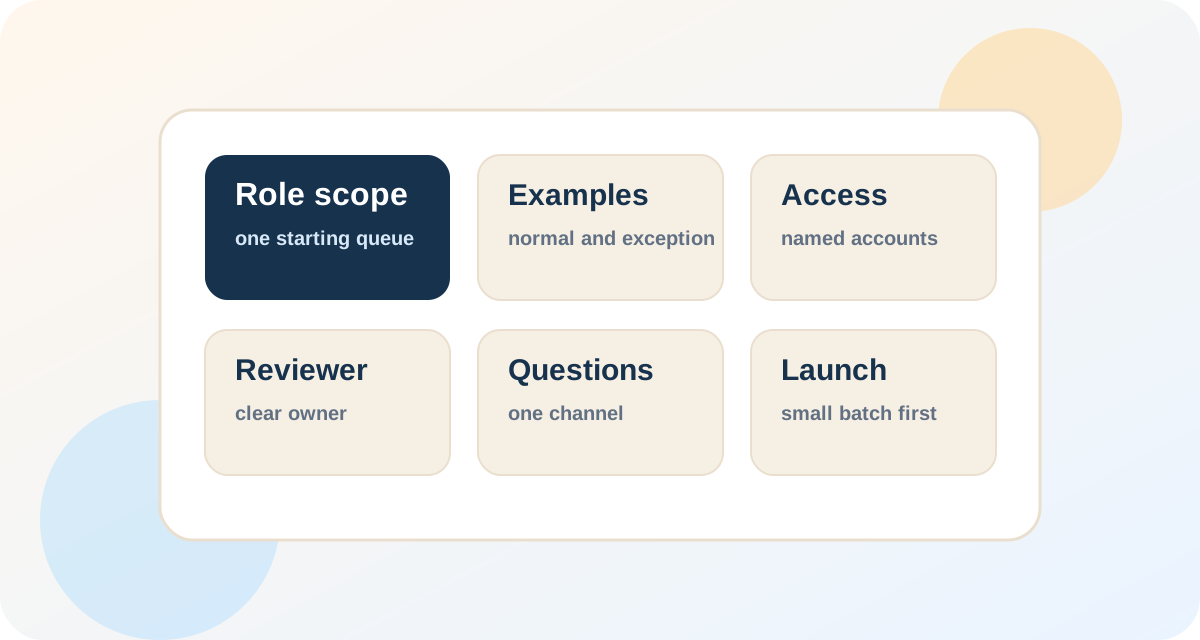
The contract must reach the work queue
The National Privacy Commission's implementing rules allow a personal information controller to outsource processing, but require contractual or other reasonable safeguards. The agreement must define subject matter, duration, nature and purpose, data types, data-subject categories, controller rights and obligations, and processing location. It must also bind the processor to documented instructions and confidentiality. Those requirements are difficult to operate if frontline tasks contain only a customer name and a deadline.
A coordinator can maintain an instruction register, connect approved requests to work items, check required fields, limit queue assignment, and preserve completion evidence. The coordinator cannot choose a lawful basis, expand a purpose, approve a new recipient, interpret a rights request, decide breach notification, or authorize indefinite retention. Those decisions belong to the controller, privacy officers, security team, and counsel.
The buyer decision is whether its governance is specific enough to direct daily work. A broad clause saying process data to provide services does not tell a worker whether an export, enrichment, reuse, or disclosure is allowed. Task-level instructions should identify the exact data, approved purpose, operation, system, recipient if any, time limit, and escalation owner.
Design one instruction record
Give each instruction an identifier and record the controller, business owner, processing purpose supplied by the owner, data-subject group, approved fields, source system, permitted operation, output destination, access role, geographic constraint, retention or deletion event, effective window, reviewer, and linked contract schedule. Store sensitive material in controlled systems and reference it from the queue.
Separate standing instructions from one-time exceptions. A standing instruction might authorize updating shipping status in a named system from an approved carrier event. A request to export all customer addresses for an unlisted analytics tool is different. It remains blocked until the authorized owner decides whether it is within scope and completes any required privacy, security, and contractual review.
Version the instruction. When a field, purpose, system, recipient, location, or retention rule changes, create a new effective version and identify affected open work. Do not edit history. Workers need to know which rule controlled their action, while reviewers need to see when and why the rule changed.
Make access follow the instruction
Access should be derived from assigned processing rather than job-title convenience. Map each task to the minimum system role, fields, export ability, and duration. The NPC rules emphasize safeguards for confidentiality, integrity, and availability, while its third-party guidance highlights continued monitoring and privacy impact assessment. A permissions list without a purpose and owner is incomplete.
Use named accounts where the system permits, approved authentication, time-bounded elevated access, and a joiner-mover-leaver process. Record grant, reviewer, use case, expiry, removal, and unresolved exceptions. A coordinator may reconcile the register with observed accounts; the system and privacy owners decide access and risk acceptance.
Monitor outputs as well as inputs. Downloads, shared files, email attachments, local copies, screenshots, and reports can extend processing beyond the primary system. The instruction should state the permitted output and secure destination. If the tool cannot enforce the boundary, the owner must approve compensating controls or choose another workflow.
Route incidents into an empowered response process
The NPC rules describe breach notification conditions and a seventy-two-hour period in specified circumstances. NPC materials also require a response team with at least one member empowered to make immediate critical decisions. A frontline coordinator should therefore report a suspected event promptly through the declared channel without trying to decide whether it is a reportable breach.
An initial record should preserve discovery time, reporter, systems, accounts, data involved if known, action observed, current exposure, containment already authorized, evidence location, and contact owner. Facts should be labeled as confirmed, reported, or unknown. Avoid copying affected personal data into an open ticket merely to prove the event.
The response owner decides containment, investigation, notification, communication, remediation, and regulator interaction. The coordinator can maintain the timeline and action log. If normal supervisors are unavailable, the documented escalation path must reach someone with authority; otherwise a beautifully organized incident record can still delay the decisions the rules contemplate.
Boundary case: an unapproved analytics export
Suppose a buyer asks an outsourced analyst to export customer email addresses and purchase history into a newly adopted analytics platform. The contract covers order support, the instruction register names only the commerce and ticketing systems, and no approved recipient or retention rule exists for the analytics tool. The analyst should stop and route the request rather than assume that business usefulness expands the purpose.
The escalation records the requester, proposed fields, subject group, source, destination, purpose claimed, geographic processing information, vendor identity, access roles, retention proposal, urgency, and existing instruction gap. Privacy, security, legal, and business owners decide whether the activity is permitted and what review or amendment is required.
If approved, issue a new instruction version, configure access, test a minimized dataset, preserve approvals, and verify deletion of temporary files. If rejected, record the decision without retaining unnecessary extracted data. This example shows why reliable outsourcing depends on explicit instructions rather than worker intuition.
Method and limitations
This study reviewed the Data Privacy Act, its implementing rules, and NPC third-party guidance checked October 5, 2026. It mapped outsourcing provisions to an operational instruction register and used one invented analytics scenario. It did not inspect a contract, processing system, privacy impact assessment, security control, incident, or organization.
It does not determine controller or processor status, lawful basis, consent, transfer rules, security sufficiency, breach status, notification duty, or retention legality. Those conclusions require current facts and qualified owners. Foreign data and other laws may also apply to a cross-border buyer.
The limited conclusion is that a coordinator can make approved instructions visible, reconcile access, log events, and preserve exit evidence. The role becomes unsafe when asked to invent purposes or decide privacy compliance. Buyers should test the instruction lifecycle before granting production data access.
Test exit before relying on it
A buyer should rehearse termination while the service is healthy. Use a controlled dataset to test account removal, work transfer, return of source material, deletion of permitted copies, backup treatment, unresolved-case routing, and evidence approval. Name systems that cannot produce deletion evidence and route that limitation to the controller.
At exit, freeze new assignments at the approved time, inventory open work, remove interactive and integration access, return required records, execute the authorized retention schedule, and collect attestations only from qualified owners. A statement that access was removed is incomplete if tokens, exports, shared links, devices, or downstream tools remain.
Reconcile the exit against the instruction register. Every active instruction should be closed, transferred, or retained under a documented owner decision. This lifecycle check shows what processing ended, what evidence remained, and which uncertainty the controller accepted.
Write the instruction before granting access
Define approved data, purpose, operation, system, output, duration, and exception owner.
Review data processing supportProcessing instruction lifecycle
| Stage | Evidence | Decision owner |
|---|---|---|
| Authorize | purpose, fields, system and duration | controller |
| Execute | named access and task record | operations |
| Exception | facts, exposure and escalation | privacy/security |
| Exit | return, deletion and access removal | controller and system owner |
Methodology
Qualitative review of the Data Privacy Act, its IRR, and NPC third-party guidance checked October 5, 2026. No real processing activity or control was assessed.
FAQ
Can a processor use data for a useful new purpose?
Not without a documented instruction and any required owner review.
Should a coordinator decide whether an incident is reportable?
No. Report promptly and let the authorized response team assess notification duties.
Sources and citation
- Data Privacy Act of 2012 (Accessed October 5, 2026)privacy.gov.ph/data-privacy-act/
- Implementing Rules and Regulations (Accessed October 5, 2026)privacy.gov.ph/implementing-rules-regulations-data-privacy-act-2012/
- NPC third-party guidance (Accessed October 5, 2026)privacy.gov.ph/third-parties/