
The buyer decision this research addresses
What should a Philippines-based support role capture and escalate when it observes a possible personal-data security incident?
This desk study is for companies considering Philippines-based support. It translates public primary sources into questions a buyer can take into scoping, contracting, onboarding, and review. It does not rate providers or workers, estimate savings, or promise an outcome. Its narrow purpose is to make a consequential decision inspectable before work begins.
Government sources establish rules, definitions, registries, or public guidance only within their scope. The operating-record recommendations in this article are FilipinoOutsource.com analysis. They are not statements by the cited institutions, and those institutions have not reviewed or endorsed this article.
What the primary sources establish
1. NPC Circular No. 16-03 requires personal information controllers and processors to maintain policies and procedures for personal-data breach management, including prevention, incident response, mitigation, and notification assessment. 2. The circular distinguishes a security incident from a personal data breach and assigns the controller responsibility for determining whether notification is required under the stated risk conditions. 3. When mandatory notification applies, the circular provides a 72-hour period from knowledge or reasonable belief of a breach and specifies information expected in the report, subject to the rule’s qualifications. 4. NPC Circular No. 2023-06 updated security obligations, including access control, incident management, business continuity, training, acceptable use, and remote deletion or disconnection measures.
These source points should be read together rather than reduced to a badge or checkbox. A registration result, signed policy, completed ticket, active account, or available worker can prove one event while leaving authority, scope, and implementation unresolved. The buyer needs evidence that identifies the responsible party, applicable instruction, source date, affected record, and next owner.
Every source listed below was checked on September 22, 2026. Public pages and issuances can later be amended, replaced, or supplemented. Before relying on the framework for a live decision, the accountable owner should verify current guidance and facts specific to the parties, work relationship, data flow, location, system, and event.
From authority to an operating record
1. Give the support role one immediate path to report suspected incidents without first deciding whether a legal breach occurred. Capture discovery time, reporter, affected system, observed event, data possibly involved, access state, preservation action, and accountable response owner. 2. Separate containment instructions from investigation and notification decisions. A worker may disconnect an account under an approved playbook, but should not delete evidence, contact affected people, or characterize legal risk without authority. 3. Make processor-to-controller timing explicit in the contract and runbook. The internal escalation target should leave enough time for the controller and qualified privacy team to investigate and meet any applicable obligation. 4. Exercise the route with a redacted scenario, then verify contact details, after-hours backup, evidence location, decision log, customer communication approval, and post-incident correction ownership.
A useful operating record is small enough to maintain and complete enough to challenge. At minimum it should identify the item, source, observed time, governing instruction, action taken, action deliberately not taken, exception, decision owner, requested response, and final disposition. When a value changes, retain the former value and reason rather than silently overwriting it.
Keep four layers distinct: a source fact, a worker transcription, an administrative classification under an approved rule, and an owner decision. Combining the layers creates false certainty. Separating them lets a reviewer correct a copied value without rewriting policy, or revise policy without pretending the earlier source never existed.
Five cases to test before scale
Test the workflow on five consecutive, appropriately redacted cases rather than polished examples selected after the result is known. Include the first five cases after a declared start point and retain incomplete, paused, and conflicting records. Consecutive review cannot produce a market benchmark, but it can reveal whether the instruction survives ordinary edge cases.
Where naturally present, the sample should include a complete case, a missing-field case, a source conflict, an authorization boundary, and a timing problem. Do not manufacture sensitive data or force every category to appear. Record categories that were absent. A reviewer should reproduce the status using the cited evidence and written rule without relying on private chat.
For every case, ask whether the input was necessary, access was appropriate, output matched the source, uncertainty was labeled, the stopped action was visible, and the question went to someone authorized to answer it. Reviewer disagreement is a finding. Preserve it, resolve the rule, and update the example before increasing volume.
A passing sample does not prove future compliance, security, or quality. It only shows that the current instruction was usable for that bounded set. Repeat the review after a source, law, purpose, system, data category, schedule, location, or responsible owner changes.
Access, handoff, and correction controls
Access should follow the required output. Give a named account only the systems, records, and functions needed for the approved task. Avoid shared credentials, broad exports, standing administrator rights, and personal-data fields retained merely because they are available. Record the approver, grant time, review date, removal trigger, and completion evidence.
Every handoff needs a receiving owner and a usable state. Done is not a state when an exception remains. Record completed work, unresolved items, evidence links, deadlines, affected people, and the next permitted action. If the receiver is unavailable, route to a declared backup rather than asking the support role to infer authority.
Correction history is part of the evidence. Preserve the original identifier, old value, new value, change source, actor, timestamp, reason, and downstream notification. A neat final record without its correction path can conceal whether an earlier decision, payment, access grant, or customer message used the wrong state.
Metrics should describe the process honestly: cases sampled, missing sources, conflicts, paused actions, reviewer disagreements, corrections, and unresolved owner decisions. Do not turn a five-case review into an accuracy rate, provider comparison, productivity claim, or statement about Filipino workers generally.
Responsibility boundary and uncertainty
Whether an event is a personal data breach, whether notification is mandatory, when knowledge occurred, which jurisdictions apply, and what containment is appropriate depend on the real facts. Only accountable privacy, security, legal, and controller representatives should make those decisions.
A support worker may retrieve approved records, transcribe defined fields, apply a written administrative label, prepare a comparison, and route a focused question. The accountable employer, controller, client manager, counsel, privacy professional, payroll professional, security lead, or other qualified owner retains decisions affecting rights, pay, classification, security, legal compliance, safety, or commitments.
A useful escalation states the conflict, evidence checked, action paused, deadline, affected party, and one question within the owner’s authority. It should not ask the owner to reconstruct the entire file, and it should not hide urgency behind a generic request for advice. The answer becomes part of the record with its author, scope, and time.
If no qualified owner exists, the workflow is not ready to scale. Additional staffing does not cure missing authority. Narrow the task, remove sensitive access, pause consequential action, and obtain professional advice when the unresolved decision requires it.
Buyer implementation sequence
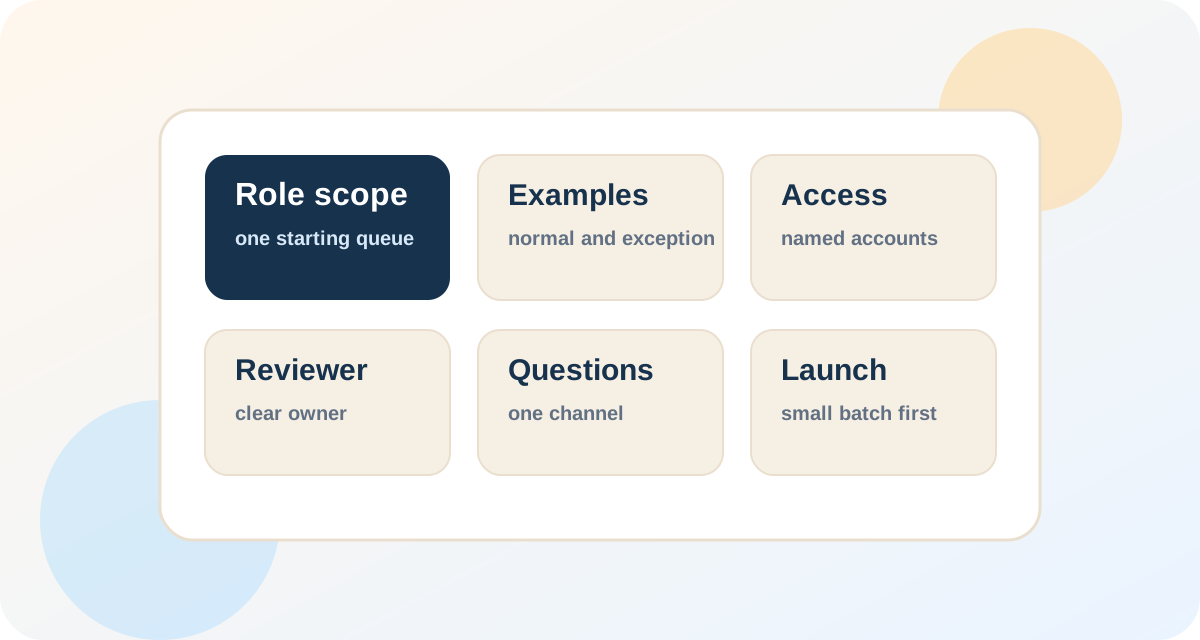
First, state the exact output and its business purpose. Second, map authoritative inputs and minimum fields. Third, name the reviewer and decisions outside the support role. Fourth, reduce access and retention to the smallest practical scope. Fifth, test consecutive cases and preserve disagreements. Sixth, revise the instruction before deciding whether volume should expand.
The commercial discussion should mirror the operating design. Ask who employs or contracts with the worker, who supervises daily work, who owns each system, who responds to incidents, who provides backup coverage, and what evidence the buyer receives. An agency label does not answer questions the actual agreement leaves open.
During the first month, examine exceptions more closely than throughput. A queue with few escalations may be clear, or workers may be guessing. Sample source-to-output accuracy and ask why work was not escalated. Treat visible uncertainty and timely stops as correct work when the instruction requires them.
At the end of the first review period, retain a decision register: what changed, why, which source supported it, who approved it, when it took effect, and when it will be revisited. This makes onboarding a controlled learning cycle instead of a one-time transfer of undocumented manager habits.
Write the incident route before granting access
Use the data processing support guide to limit accounts, define evidence fields, and name the client privacy and security owners who receive an incident escalation.
Review data processing supportMethodology
Qualitative desk review of 3 primary Philippine government sources, checked September 22, 2026. The analysis separated explicit source statements from buyer-side workflow inferences, then tested the proposed record against complete, missing, conflicting, authorization-boundary, and timing scenarios. No provider, worker, client, production system, personal data, price, or outcome was studied. The method cannot establish prevalence, performance, legal compliance, or causation.
FAQ
Is this legal, payroll, privacy, security, or tax advice?
No. It is a buyer-side research and workflow framework. Qualified advisers and accountable owners must decide how current rules apply to the real facts.
Does a five-case sample prove performance?
No. It tests whether a written instruction is usable on a bounded set and makes exclusions and disagreement visible.
What should the support role own?
Approved evidence gathering, defined administrative fields, status preparation, correction records, and focused escalation—not consequential decisions outside written authority.
When should the workflow be reviewed again?
After a change in law or guidance, purpose, system, data, location, schedule, responsible owner, or recurring exception pattern.
Sources and citation
- National Privacy Commission — Circular No. 16-03, Personal Data Breach Management (Accessed September 22, 2026)privacy.gov.ph/wp-content/uploads/2016/12/sgd-npc-circular-16-03-personal-data-breach-management.pdf
- National Privacy Commission — Circulars strengthening personal-data protection (Accessed September 22, 2026)privacy.gov.ph/npc-issues-circulars-to-strengthen-personal-data-protection-in-ph/
- National Privacy Commission — Data Privacy Act implementing rules (Accessed September 22, 2026)privacy.gov.ph/implementing-rules-regulations-data-privacy-act-2012/