
The decision is about the operating facts
Philippines outsourcing buyers sometimes treat a signed services agreement as the end of workforce due diligence. DOLE Department Order No. 174 takes a more factual view of contracting and subcontracting arrangements where an employer-employee relationship exists. It prohibits labor-only contracting, describes permissible arrangements, protects labor standards and security of tenure, and requires contractor registration. A buyer therefore needs to understand how work will actually be organized, not simply accept a vendor label.
An administrative coordinator can assemble provider records, maintain expiry dates, record the approved scope, schedule reviews, and surface differences between the contract and daily practice. That role must not decide whether an arrangement is legally permissible, whether employment exists, or which party bears a statutory obligation. Those are consequential conclusions for Philippine counsel and accountable business owners using current facts.
The practical question is whether the buyer can demonstrate who supplies tools and supervision, who controls methods and schedules, what result the provider owns, how workers raise concerns, and what happens when the scope changes. If the answer lives only in sales language, the operation is not ready. A review pack should join commercial promises to observable controls and named decision owners.
Build a provider identity and authority record
Start with the provider legal name, registration identifiers supplied for review, business address, authorized representative, contracting registration evidence where applicable, validity period, proposed services, work locations, subcontractors, insurance or bond evidence requested by the owner, and the source from which each item was obtained. Record who verified each item and when. A logo, proposal, or email domain is not a legal identity check.
Treat registration as one input, not a complete conclusion. DOLE describes mandatory contractor registration and procedures for cancellation, but a certificate cannot prove that every later work arrangement is permissible. Preserve the exact document, verify it through the approved route, note its scope and dates, and send ambiguity to counsel. Never alter an identifier or infer continuing validity from an old copy.
The buyer should also identify its own accountable parties: commercial owner, operational owner, information-security reviewer, privacy officer when personal data is involved, finance approver, and legal adviser. Due diligence fails when everyone assumes another function reviewed the same evidence. A responsibility matrix should state the question each owner decides and what evidence reaches them.
Describe the work before comparing controls
Create a task inventory that names deliverables, inputs, systems, working hours, dependencies, quality measures, exception paths, and prohibited actions. Then describe who assigns work, who chooses methods, who monitors attendance, who evaluates performance, who supplies equipment, and who may remove a worker from the account. These observations help advisers evaluate substance without asking a coordinator to make the legal classification.
Avoid vague scope phrases such as virtual assistance or back-office support. They hide whether the operation is a defined service, staff augmentation, recruitment, or another arrangement. Break the scope into repeatable outputs and decisions. For each output, identify provider supervision, buyer acceptance criteria, credential boundaries, and the person who resolves an exception.
Interview the proposed provider and the buyer team separately, then reconcile differences. A contract may say the provider supervises work while a launch plan gives individual buyer managers direct scheduling and disciplinary authority. The coordinator records that inconsistency verbatim and routes it before launch. Silence or a reassuring paraphrase is not resolution.
Use a change trigger, not an annual ritual
Review must reopen when the buyer adds a new function, changes shifts, embeds workers in a buyer team, transfers tools, changes the person directing work, replaces a subcontractor, moves the worksite, or alters how performance is managed. These events can change the factual arrangement even when the agreement and monthly fee remain unchanged.
Maintain a change log with request, reason, affected tasks, proposed control, worker impact, system access, owner approvals, effective date, and evidence after implementation. A coordinator may compare the new state with the approved model. The legal and operational owners decide whether an amendment, new review, or stop is required.
Sample actual work after launch. Select consecutive work items and trace who assigned them, who supervised execution, which tools were used, how acceptance occurred, and how an exception was handled. This is not an employment audit. It is a disciplined way to determine whether the approved operating narrative still resembles reality.
Boundary case: direct buyer supervision expands
Assume a provider initially owns a documented invoice-indexing service. Three months later, buyer managers begin assigning unrelated tasks directly to named workers, approving leave informally, setting individual daily schedules, and scoring personal performance. The contract has not changed. The coordinator should preserve the observed instructions, compare them with the approved responsibility matrix, and escalate the divergence.
A useful escalation names the affected service, dates, sample instructions, current contract language, provider supervisor, buyer managers, worker group, systems involved, and immediate operational need. It asks the provider, business owner, and counsel what interim boundary applies and whether the service design must change. The coordinator should not accuse a party of unlawful conduct or quietly rewrite the record.
After a decision, update the scope, communication channels, supervisor map, acceptance process, and review date. Retain the earlier state and decision evidence. If owners direct a pause, record what work stopped and how customer or financial risk was contained. The reader outcome is a controlled response to factual drift, not a promise that a checklist determines legality.
Method, limits, and buyer conclusion
This research qualitatively reviewed DOLE Department Order No. 174 and DOLE's official explanatory release, both checked October 5, 2026. It mapped published contracting principles to a buyer evidence workflow and tested a hypothetical supervision change. It did not inspect a provider, worker relationship, contract, registration, payroll, worksite, or government record.
Nothing here is legal advice or a determination of employment status, permissible contracting, registration validity, labor standards compliance, liability, or remedy. Current law, later issuances, and specific facts control. Buyers should obtain qualified Philippine advice and use official verification channels before making a consequential decision.
The bounded conclusion is operational: due diligence is stronger when provider identity, approved scope, real supervision, worker-facing channels, access, and change evidence are reviewed together. An outsourced coordinator can maintain that evidence and surface drift. The buyer and qualified professionals retain every legal, commercial, and employment decision.
Set a review cadence from operating risk
Set review frequency from worker count, access, task volatility, subcontracting, customer impact, and earlier exceptions. Record why the cadence was chosen and who may accelerate it. A calendar reminder is useful only when the reviewer opens current evidence and records a conclusion. Between formal reviews, require managers to report changes to supervision, systems, work location, provider identity, and task scope. This gives the evidence owner a defined trigger instead of relying on memory.
Turn due diligence into launch controls
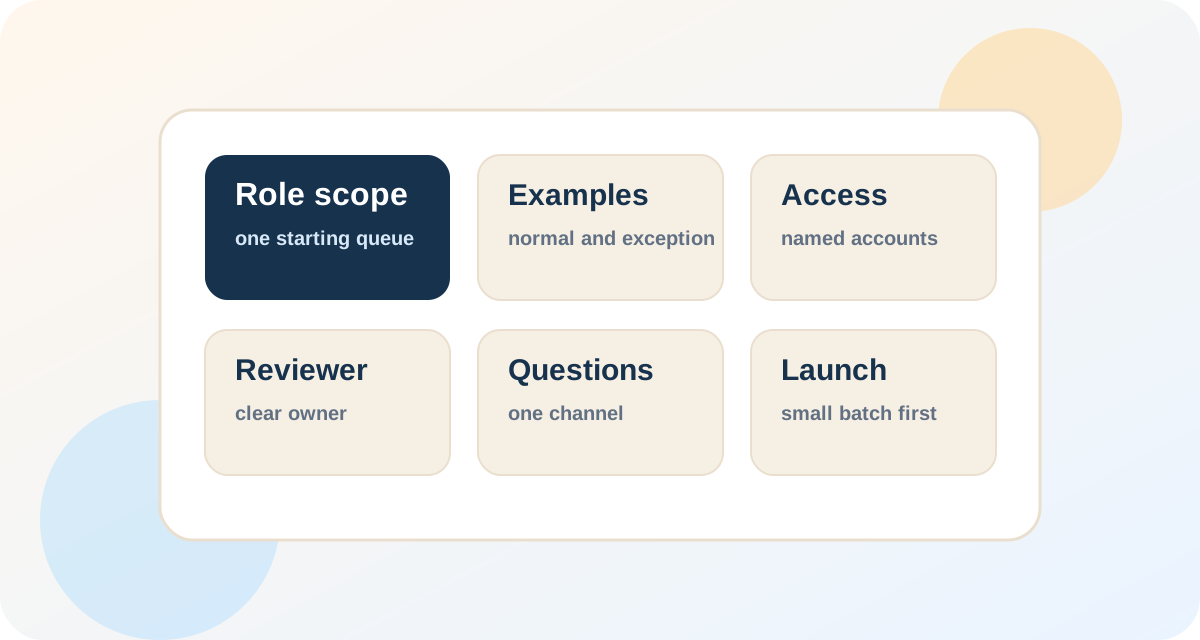
Define the service, supervision map, evidence owners, access boundary, and change triggers before work starts.
Review outsourcing servicesContractor review gates
| Gate | Coordinator evidence | Owner decision |
|---|---|---|
| Identity | official identifiers and dated records | provider approval |
| Scope | tasks, tools, supervision and outputs | operating model |
| Launch | access, channels and exception map | release |
| Change | observed drift and decision record | amend, continue or stop |
Methodology
Qualitative review of DOLE Department Order No. 174 and the official DOLE explanatory release, checked October 5, 2026; mapped to a buyer evidence workflow with one hypothetical drift scenario. No actual arrangement was assessed.
FAQ
Does contractor registration make every arrangement permissible?
No. Registration is one record; qualified owners must assess the actual arrangement under current rules.
Can an operations coordinator classify employment?
No. The coordinator records facts and routes questions to accountable legal and business owners.
Sources and citation
- Philippine eFOI — DOLE response on Department Order No. 174 (Accessed October 5, 2026)www.foi.gov.ph/agencies/dole/do174/
- DOLE explanation of Department Order No. 174 (Accessed October 5, 2026)dole.gov.ph/news/bello-signs-d-o-on-contracting-and-subcontracting/