
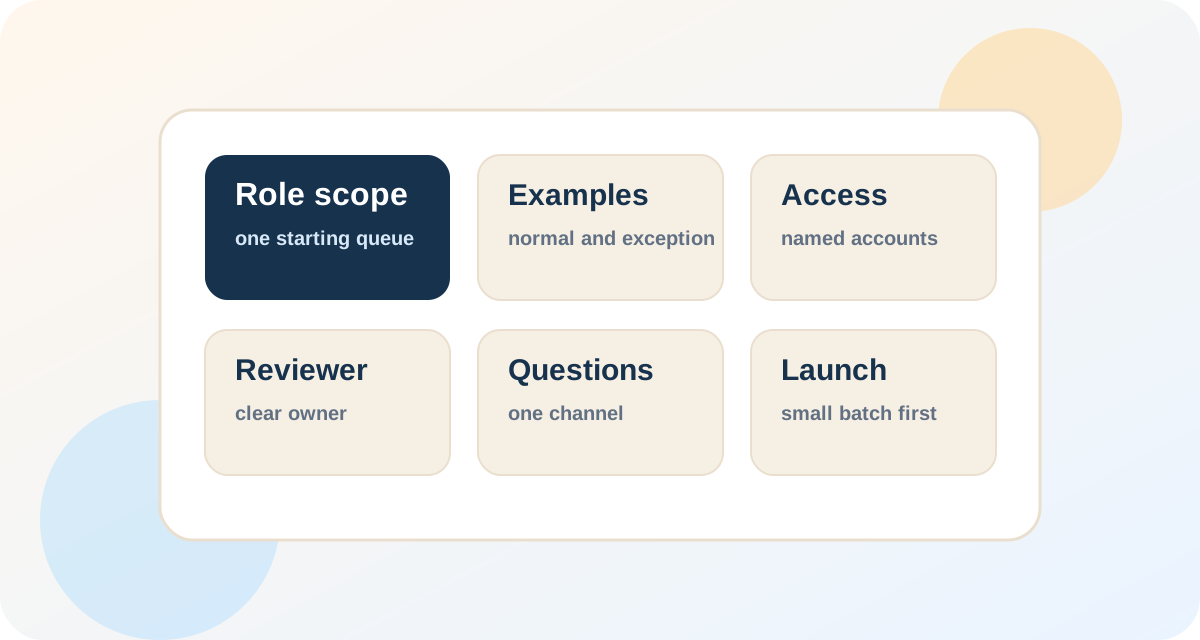
The decision this consent withdrawal operations study can support
How can a Philippines-based support team execute an approved consent-withdrawal decision without treating every unsubscribe, deletion request, objection, and account closure as the same event?
This article is a desk review for a buyer designing a Philippines-based support role. It evaluates the evidence needed to prepare, route, verify, and correct consent withdrawal operations; it does not certify a provider, decide an employer duty, or promise a result. Facts attributed to public authorities are separated below from FilipinoOutsource.com operating analysis, the hypothetical boundary case, and unresolved questions.
The useful unit of review is one real case with a declared start point and controlled source version. Totals, dashboard states, certificates, and tickets are supporting signals, not substitutes for person-level or transaction-level evidence. The buyer should name the person authorized to decide exceptions before access is granted, then preserve both the decision and proof of execution.
Primary-source findings for consent withdrawal operations
National Privacy Commission Circular No. 2023-04 says consent must be specific, informed, freely given, evidenced, and capable of withdrawal; electronic consent should not be made materially easier to give than to withdraw. For consent withdrawal operations, the 1th source point requires a purpose-level record rather than a single customer flag. The operations team should identify which consent event, notice, processing purpose, system, recipient, and downstream audience are implicated, then wait for the controller's decision where another basis or retention duty may exist. This prevents a marketing suppression from being misrepresented as universal deletion and prevents unrelated processing from continuing on an obsolete permission.
The NPC guidance states that withdrawal does not invalidate processing that occurred before withdrawal and that the controller must explain relevant consequences and consider retention where another basis or duty applies. For consent withdrawal operations, the 2th source point requires a purpose-level record rather than a single customer flag. The operations team should identify which consent event, notice, processing purpose, system, recipient, and downstream audience are implicated, then wait for the controller's decision where another basis or retention duty may exist. This prevents a marketing suppression from being misrepresented as universal deletion and prevents unrelated processing from continuing on an obsolete permission.
The Data Privacy Act separately requires specified purposes, proportionality, accuracy, limited retention, transparency, and a lawful condition for processing, so a consent record is not a universal authority for every purpose. For consent withdrawal operations, the 3th source point requires a purpose-level record rather than a single customer flag. The operations team should identify which consent event, notice, processing purpose, system, recipient, and downstream audience are implicated, then wait for the controller's decision where another basis or retention duty may exist. This prevents a marketing suppression from being misrepresented as universal deletion and prevents unrelated processing from continuing on an obsolete permission.
Operations personnel may authenticate, map records, suppress approved purposes, and document execution. They should not invent a lawful basis, decide that withdrawal is ineffective, erase protected evidence, or promise deletion from every live and backup system. For consent withdrawal operations, the 4th source point requires a purpose-level record rather than a single customer flag. The operations team should identify which consent event, notice, processing purpose, system, recipient, and downstream audience are implicated, then wait for the controller's decision where another basis or retention duty may exist. This prevents a marketing suppression from being misrepresented as universal deletion and prevents unrelated processing from continuing on an obsolete permission.
Operating controls for consent withdrawal operations
Capture requester identity, channel, received time, exact wording, consent event or notice version, purpose or campaign named, products and accounts implicated, systems likely involved, controller identity, requested effective scope, and acknowledgement sent. Validate control 1 by tracing one request across the consent store, customer platform, marketing tool, analytics audience, and processor instruction where those systems actually apply. Compare the approved purpose map with execution evidence and keep failed synchronizations open. The review should not infer that silence from one application proves erasure elsewhere. It should name every checked boundary, retained record, unresolved copy, responsible owner, and communication sent to the requester.
Build a purpose-by-system map rather than one global flag. For each processing purpose, record the data used, consent evidence if relied on, recipient or processor, automated audience, current owner, proposed action, other-basis question, retention issue, and decision authority. Validate control 2 by tracing one request across the consent store, customer platform, marketing tool, analytics audience, and processor instruction where those systems actually apply. Compare the approved purpose map with execution evidence and keep failed synchronizations open. The review should not infer that silence from one application proves erasure elsewhere. It should name every checked boundary, retained record, unresolved copy, responsible owner, and communication sent to the requester.
After owner approval, execute suppression, preference change, list removal, audience exclusion, API or processor instruction, and downstream notification as separate tasks. Verify each result with timestamps and controlled identifiers and quarantine failed synchronizations. Validate control 3 by tracing one request across the consent store, customer platform, marketing tool, analytics audience, and processor instruction where those systems actually apply. Compare the approved purpose map with execution evidence and keep failed synchronizations open. The review should not infer that silence from one application proves erasure elsewhere. It should name every checked boundary, retained record, unresolved copy, responsible owner, and communication sent to the requester.
Preserve the earlier consent evidence, withdrawal request, decision, lawful-basis reasoning by the accountable owner, actions completed, residual copies, retention schedule, user communication, exception, and later re-consent without turning an old consent into permission for a new purpose. Validate control 4 by tracing one request across the consent store, customer platform, marketing tool, analytics audience, and processor instruction where those systems actually apply. Compare the approved purpose map with execution evidence and keep failed synchronizations open. The review should not infer that silence from one application proves erasure elsewhere. It should name every checked boundary, retained record, unresolved copy, responsible owner, and communication sent to the requester.
Boundary case: where administrative support must stop
A user clicks “unsubscribe” from a newsletter, then asks support to delete the account while an unpaid invoice and fraud review remain open. Marketing suppression can proceed under the defined rule, but the worker cannot assume the same action controls billing, security evidence, account records, and backups.
The coordinator's first task is to preserve what was received and compare it with the current approved instruction. The worker may identify the exact mismatch, protect the evidence, pause the affected administrative action where the playbook requires it, and send a focused question to the named owner. The worker must not convert urgency, a familiar precedent, or a senior request into authority that the role does not hold.
A useful escalation contains the case identifier, observed facts, source version, affected people or records, event time, action already completed, action deliberately withheld, deadline, controlled evidence location, and requested decision. The owner's response needs scope, author, conditions, effective time, and expiry. Later verification should compare the actual system or account result with that recorded decision rather than accepting a verbal assurance.
A bounded review before scaling consent withdrawal operations
Start with five consecutive eligible cases after a recorded cutoff. Include incomplete, rejected, corrected, and disputed items when they occur; do not replace them with cleaner examples. For each case, record the authoritative input, instruction version, preparer, reviewer, system response, owner decision, final observable state, and unresolved exception. State the denominator and every exclusion before calculating any completion or exception rate.
Review the exceptions more closely than the volume. Ask whether the worker could find the current source, whether identifiers stayed in approved systems, whether the right event triggered a stop, whether the owner received enough context to answer, and whether downstream records reflected the decision. Repeat the review after a rule, party, data field, system, payment channel, approval role, or retention practice changes. Earlier evidence describes an earlier configuration only.
Limitations, uncertainty, and accountable ownership
Whether consent is required, whether another lawful basis applies, how identity should be checked, what must be retained, which recipients must act, and what the requester must be told depend on the actual processing. The controller and qualified privacy advisers must decide.
The sources were checked September 28, 2026. A checked date records the desk review; it does not guarantee that a portal, form, circular, interpretation, schedule, or organization-specific fact will remain unchanged. Recheck the controlling authority before a consequential action. The hypothetical examples do not describe a customer, worker, provider, or measured company result.
Administrative support can gather approved inputs, populate defined fields, compare records, preserve history, and route exceptions. The employer, controller, taxpayer, safety owner, privacy officer, finance lead, counsel, or other qualified professional retains decisions within their remit. The process should name a primary owner and backup and should treat a required stop as correct work, not as a productivity failure.
Map consent to real systems and purposes
Use the customer support operations guide to define authenticated intake, approved status changes, privacy-owner decisions, downstream execution, and verification.
Review customer support operationsMethodology
Qualitative desk review of 3 primary Philippine government sources, checked September 28, 2026. The method separated authority statements from operating inferences, applied them to one hypothetical boundary, and defined a five-case consecutive test. No provider, employee, taxpayer, personal data, production account, filing, payment, injury, or legal outcome was tested; this method cannot establish prevalence, causation, compliance, service quality, or professional conclusions.
FAQ
Is this legal, privacy, employment, security, or tax advice?
No. It is a buyer-side research and workflow framework. Qualified advisers and accountable owners must decide how current rules apply to real facts.
Does a five-case review prove quality or compliance?
No. It tests whether the current written instruction is usable on a bounded set and exposes exclusions, uncertainty, and disagreement.
What may the support role own?
Approved evidence gathering, defined administrative fields, status preparation, correction records, and focused escalation—not consequential decisions outside written authority.
When should the record be reopened?
When purpose, source, data, party, contract, system, tool, location, reviewer, consequence, law, or retention practice changes.
Sources and citation
- National Privacy Commission — Circular No. 2023-04 Guidelines on Consent (Accessed September 28, 2026)privacy.gov.ph/wp-content/uploads/2024/05/2023-compendium-2.pdf
- National Privacy Commission — Data Privacy Act of 2012 (Accessed September 28, 2026)privacy.gov.ph/data-privacy-act/
- National Privacy Commission — Advisory No. 2021-01 on Data Subject Rights (Accessed September 28, 2026)privacy.gov.ph/wp-content/uploads/2021/02/NPC-Advisory-2021-01-FINAL.pdf