
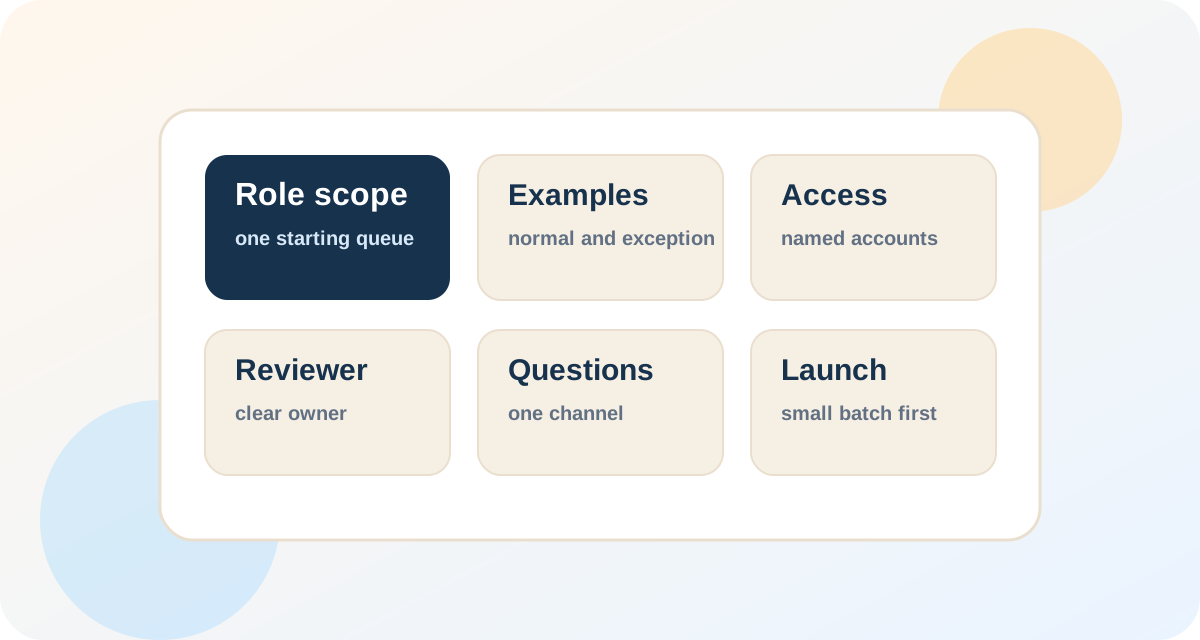
Research question and scope
What does a consecutive-case rule reveal that a hand-picked showcase cannot?
This study examines designed Filipino outsourcing workflow records containing population rule, start event, case order, inclusion state, exclusion reason, instruction version, reviewer result, and correction. It tests whether a second reviewer can reconstruct the administrative state without private messages.
Source framework
National Privacy Commission guidance informed purpose limitation, proportionality, accuracy, and security. NIST informed identity and access lifecycle concepts; CISA informed event logging; PSA technical notes informed definitions and reference periods.
Those institutions did not evaluate FilipinoOutsource.com or endorse this workflow. Their publications are source frameworks; the operational application is our analysis.
Record-reading method
Five designed records were read in their original order, including incomplete and conflicting cases. The field set was population rule, start event, case order, inclusion state, exclusion reason, instruction version, reviewer result, and correction.
The first reading separated source facts from client-defined labels. The second asked whether another reviewer could reproduce the timeline, identify the paused action, and locate the accountable owner.
Boundary case
A pilot presents five polished cases while two incomplete records and one system outage between them are omitted.
The reviewable response retains the earlier state, later evidence, retrieval times, and any downstream handoff. It does not silently rewrite history or decide which consequential outcome should follow.
Finding and decision boundary
Consecutive review exposes exclusions and exceptions that disappear when examples are selected after outcomes are known.
An assistant may retrieve approved evidence, record events, apply written labels, and route exceptions. Legal, financial, clinical, security, employment, safety, regulatory, and commercial decisions remain with authorized owners.
Limitations and validation
Five designed cases are not a statistical sample and cannot establish error rates, service levels, or provider performance.
A buyer should test the field definitions, retention, access, reviewer agreement, and exception ownership in its own systems before increasing volume. No live workers, providers, clients, customers, or production outcomes were studied.
Methodology
Qualitative desk analysis of five designed review design records. The fixed observation window was September 1 through September 14, 2026. Records were evaluated twice against a declared field set, with every incomplete record and exclusion retained. This was not a statistical sample; no live personal data, production systems, providers, workers, customers, or outcomes were observed, and no benchmark or causal claim is made.
FAQ
Does this study establish a performance benchmark?
No. It proposes observable fields and a bounded validation method for a buyer to test.
What may an assistant decide?
An assistant may apply written administrative labels and route evidence; authorized owners retain consequential decisions.
What was the observation window?
The designed desk review covered September 1 through September 14, 2026.
Sources and citation
- National Privacy Commission: Data Privacy Act of 2012privacy.gov.ph/data-privacy-act/
- NIST: Digital Identity Guidelinespages.nist.gov/800-63-4/
- CISA: Logging Made Easywww.cisa.gov/resources-tools/services/logging-made-easy
- Philippine Statistics Authority: Technical Notespsa.gov.ph/statistics/technical-notes/165790