
The buyer decision
When software scores, ranks, recommends, or classifies a person, what review boundary should a buyer set for a Philippines-based support team?
This research addresses automated-decision human review as a buyer-governance decision, not as a shortcut for assigning more work. A Philippines-based support role may prepare evidence, apply an approved administrative rule, and route a focused exception. It should not create the legal basis, approve a consequential use, or convert a tool output into an owner decision.
The distinction matters because an apparently small workflow change can alter the people, data, systems, locations, and vendors involved. Buyers need a record that can be checked before launch and revisited after the product, instruction, or purpose changes. A policy name alone does not reveal whether the live configuration follows it.
This is qualitative desk research. It does not study Filipino workers, compare providers, test a production system, or estimate cost, speed, accuracy, risk reduction, or legal compliance. The article translates current primary-source material into a bounded review framework for FilipinoOutsource.com buyers.
What the primary sources establish
1. NPC Advisory No. 2024-04 calls for meaningful human intervention by people with the competence and authority needed when automated decisions pose significant risk to data subjects’ rights and freedoms. 2. The advisory also addresses mechanisms for data subjects to question and contest relevant automated decisions, along with fairness, accuracy, transparency, security, and continuing monitoring. 3. NPC rules define automated decision-making for registration and notification purposes and address systems that become the sole basis for decisions that significantly affect a data subject. 4. A person clicking approve does not necessarily make review meaningful if the reviewer cannot inspect relevant inputs, understand the output’s role, identify limitations, change the result, or record reasons.
The sources were checked on September 23, 2026. They establish duties, definitions, and regulatory guidance within their stated scope. They do not endorse FilipinoOutsource.com, a vendor, an AI model, or the operating design proposed here. The fields and tests below are our analysis for making automated-decision human review reviewable.
Source language and operational inference must remain separate. A source statement should retain its publisher, title, URL, checked date, and relevant scope. A buyer-side interpretation should be labeled as analysis and approved by the person accountable for the real workflow. If a source later changes, the team should preserve the former review date and open a new assessment rather than silently rewriting history.
Public guidance cannot answer facts that exist only inside a client’s contract, system configuration, data map, workforce relationship, or decision process. Those local facts need named owners and supporting evidence. Where a question requires legal, privacy, employment, security, financial, or other professional judgment, the queue should stop and route it.
The minimum review record
1. Map the decision before assigning the queue: affected person, input data, source owner, model or rule version, output, threshold, consequence, permitted reviewer action, escalation owner, explanation record, contest route, and monitoring trigger. 2. Give support staff an evidence-preparation role only where appropriate: confirm identifiers, retrieve approved inputs, record missing data, preserve output and version, route anomalies, and assemble a review packet without treating the score as fact. 3. Place consequential authority with a competent person who can assess the underlying case, reject or change the recommendation, explain the actual reason, identify uncertainty, and recognize when specialist legal, employment, clinical, financial, or privacy review is needed. 4. Sample disagreements and overrides, not only approvals. Record input corrections, model changes, unavailable explanations, repeat impacts, contest outcomes, and cases that never reached review so monitoring does not reward automatic acceptance.
A useful record distinguishes proposal, approval, implementation, and later verification. Proposal captures what someone wants to change. Approval identifies who had authority and what conditions applied. Implementation records the actual account, configuration, version, and date. Verification tests whether the deployed workflow matches the approval. Combining those events into one completed checkbox hides drift.
The record should also preserve negative evidence. If no personal data was used, no onward provider was involved, no automated consequence occurred, or no public distribution took place, record how that was checked and the boundaries of the observation. Absence is not permanent: a connector, feature, new source field, or changed audience can make the earlier conclusion stale.
Use stable identifiers where possible: contract or instruction version, system name, account, case, source URL, file hash, model or rule version, approval ticket, and affected workflow. Narrative remains useful for uncertainty, but a reviewer should not have to search chat history to learn which product, person, or dataset the note concerns.
A boundary case to test
A recruiting coordinator receives an AI-generated candidate ranking and is asked to reject every person below a threshold even though the team cannot see the model inputs, reason codes, or correction path.
The support role should first preserve the request and identify the action that has not yet occurred. Next, it should compare the request with the approved tool, source, data, purpose, and authority record. Any mismatch should be stated in concrete terms: which field, party, configuration, or consequence differs. The handoff should ask one answerable question of a named owner.
The owner may reject the proposal, narrow the fields, require a different account, obtain specialist review, add safeguards, approve a controlled test, or authorize the use with stated conditions. The coordinator records the answer and effective time but does not enlarge it by analogy. Approval for one dataset, audience, campaign, customer, or decision is not standing approval for every similar-looking task.
After the action, verify the result against the decision. Check actual access, stored artifacts, publication or distribution state, audit evidence, exception handling, and removal path. If the system does not expose enough evidence, record that limitation rather than inventing certainty. A workflow that cannot be inspected may need a narrower role or a different system.
Access, handoff, and correction controls
Access should follow the approved output. Give each worker a named account with the least practical records and functions, and keep account approval, grant, review, and removal as separate events. Shared credentials and broad exports weaken attribution. Temporary access needs an expiry or removal trigger that someone is responsible for checking.
A cross-time-zone handoff needs item status, evidence checked, action completed, action paused, deadline, affected person or system, and receiving owner. “Done” is misleading when publication, release, rejection, deletion, payment, access, or customer communication still requires authorization. The receiving owner should be able to reproduce the question without a private call.
Corrections should preserve the former value, new value, source for each, actor, reason, event time, downstream effect, and notice sent. Overwriting a prompt, score, source identity, approval, vendor name, or media file can conceal which state informed an earlier decision. A correction log supports review; it does not prove intent or erase the earlier consequence.
Retention should be tied to the declared purpose and actual obligation. A convenient archive is not automatically necessary. Buyers should decide which evidence proves the control, which data can be minimized or redacted, who can retrieve it, and what happens to copies, logs, backups, exports, and integrated systems when the work ends.
How to test the workflow without overstating results
Begin with five consecutive eligible cases after a declared start point. Do not choose only polished successes. Include incomplete, paused, corrected, and disputed cases when they naturally occur, and record why any case is excluded. This sample can test whether the instruction is usable; it cannot establish a provider-wide accuracy rate or predict future performance.
For each case, ask whether the source was identifiable, the minimum data rule was followed, the instruction version was current, the worker stayed inside authority, the owner received an answerable escalation, and the final state matched the approval. Record reviewer disagreement as evidence about the rule rather than forcing agreement to improve a score.
Useful measures are descriptive: eligible cases, missing sources, unexpected data, unapproved tools or parties, paused actions, owner response events, corrections, overrides, removal requests, and unresolved exceptions. Each count needs a denominator, time period, inclusion rule, and source. None of these measures alone proves compliance, safety, fairness, or worker quality.
Repeat the review after a change in law or guidance, business purpose, data category, vendor, tool feature, model, integration, system location, affected population, reviewer, decision consequence, or retention practice. A previously sound record is evidence of an earlier state, not a permanent certification.
Limits, uncertainty, and accountable ownership
Whether a workflow is automated decision-making, significantly affects a person, requires registration or notice, or provides meaningful intervention depends on the system and real consequence. This article is not a compliance determination or employment decision.
The accountable client, employer, personal information controller, processor, data protection officer, security owner, counsel, or other qualified professional must decide questions within their authority. Titles vary by organization, but the escalation record should name an individual or controlled role rather than an unspecified department.
Workers also need a protected way to stop. Throughput pressure, a deadline, a senior requester, or a familiar-looking example should not substitute for missing permission. The stop record should state what was requested, which evidence was checked, which action remains paused, when a response is needed, and what safe alternative remains available.
The evidence-led conclusion is narrow: automated-decision human review is more defensible when purpose, source, data, system, authority, human review, exceptions, correction, and exit evidence remain visible. A Philippines-based support role can maintain that record and prepare bounded work. It should not be made responsible for resolving uncertainty that belongs to a qualified owner.
A practical buyer sequence
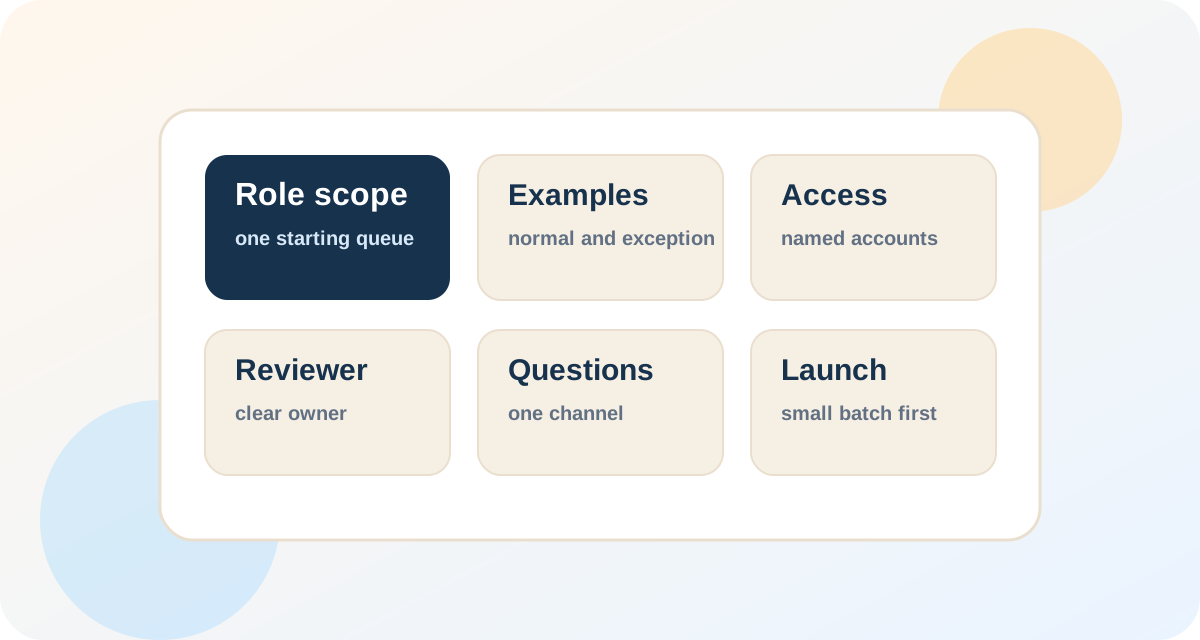
First, describe one finished output in plain language. Second, identify its source facts and minimum necessary data. Third, map every system and organization that can receive or retain those inputs and outputs. Fourth, name the reviewer and decisions that remain outside the support role. Fifth, test redacted or synthetic examples before opening live access.
Next, run the bounded sample and inspect exceptions more closely than volume. Ask whether workers could see the current instruction, whether owners answered the question posed, and whether actual configuration matched the documented design. Revise the rule where the same ambiguity repeats; do not rely on private corrections that later shifts cannot see.
Finally, retain a dated decision register. It should show the proposed change, sources reviewed, uncertainties, owner, decision, conditions, implementation evidence, later corrections, review trigger, and exit result. This turns adoption into a controlled learning cycle without implying that documentation alone makes the underlying activity lawful or safe.
For a commercial conversation, ask who controls the purpose, who supplies the tool, who contracts with the worker, who can see the records, who responds to an incident or rights request, who approves external communication, and what evidence the buyer receives. If those answers remain vague, narrow the work before adding data or volume.
Keep candidate decisions with the hiring owner
Use the recruitment coordination guide to separate scheduling and evidence preparation from screening criteria, automated recommendations, accommodations, and final hiring decisions.
Review recruitment coordinationMethodology
Qualitative desk review of 3 primary National Privacy Commission sources, checked September 23, 2026. The method separated explicit source propositions from FilipinoOutsource.com operating analysis, then applied the framework to a hypothetical boundary case and a five-case consecutive review design. No live workflow, provider, worker, personal data, model, product, price, or business outcome was tested.
FAQ
Does this article approve a tool or workflow?
No. The accountable buyer and qualified owners must evaluate the real purpose, parties, data, configuration, contracts, risks, and applicable law.
What may the support role own?
Approved evidence gathering, defined administrative preparation, source and version records, focused escalation, and correction evidence—not consequential decisions beyond written authority.
Does a five-case review prove performance or compliance?
No. It tests whether the current instruction is usable on a bounded set and exposes exclusions, uncertainty, and disagreement.
When should the record be reopened?
When purpose, source, data, tool, party, feature, model, location, audience, reviewer, consequence, law, or retention practice changes.
Sources and citation
- National Privacy Commission — Advisory No. 2024-04 on AI systems processing personal data (Accessed September 23, 2026)privacy.gov.ph/wp-content/uploads/2024/12/Advisory-2024.12.19-Guidelines-on-Artificial-Intelligence-w-SGD.pdf
- National Privacy Commission — Circular No. 17-01 on automated decision-making (Accessed September 23, 2026)privacy.gov.ph/npc-circular-17-01-registration-data-processing-notifications-regarding-automated-decision-making/
- National Privacy Commission — Data Privacy Act implementing rules (Accessed September 23, 2026)privacy.gov.ph/implementing-rules-regulations-data-privacy-act-2012/