
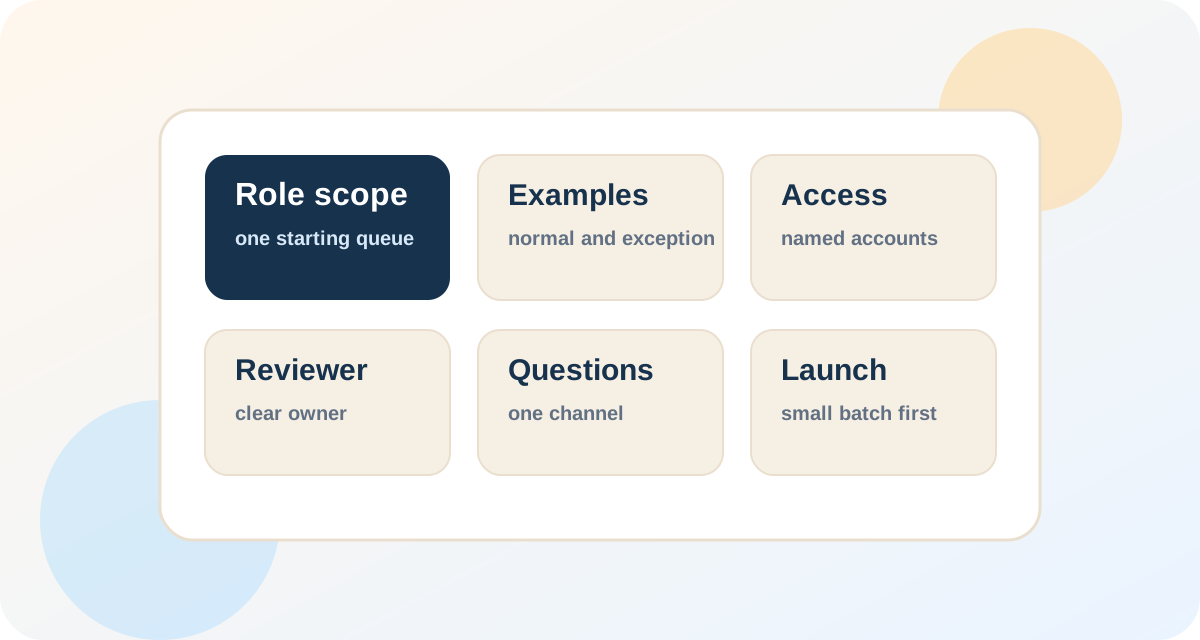
Study stage 1: population
Publish population, inclusion rules, observation window, systems, roles, time zones, and unavailable evidence before results are known. For where does information disappear during filipino support handoffs?, retain the first-pass result, cited artifact, confidence, unresolved question, and accountable owner so another authorized reviewer can reproduce the conclusion.
Calibration includes a normal record, a deliberately ambiguous record, a missing artifact, and a consequential exception. Delay one acknowledgement and introduce one plausible conflict. Observe whether reviewers preserve uncertainty, remain within permissions, and route the exact decision instead of repairing the record by assumption.
For stage 1, publish the expected artifact, reviewer role, acceptable evidence, exclusion rule, response clock, and closure condition before sampling. Compare source timestamps in a declared timezone and keep unavailable evidence visible. Where reviewers disagree, report each classification and its consequence before consensus; do not replace the original result with a clean final answer.
Study stage 2: evidence model
Keep source fact, Filipino staff preparation, client decision, executed action, communication, and verified outcome in separate fields. For where does information disappear during filipino support handoffs?, retain the first-pass result, cited artifact, confidence, unresolved question, and accountable owner so another authorized reviewer can reproduce the conclusion.
Calibration includes a normal record, a deliberately ambiguous record, a missing artifact, and a consequential exception. Delay one acknowledgement and introduce one plausible conflict. Observe whether reviewers preserve uncertainty, remain within permissions, and route the exact decision instead of repairing the record by assumption.
For stage 2, publish the expected artifact, reviewer role, acceptable evidence, exclusion rule, response clock, and closure condition before sampling. Compare source timestamps in a declared timezone and keep unavailable evidence visible. Where reviewers disagree, report each classification and its consequence before consensus; do not replace the original result with a clean final answer.
Study stage 3: access boundary
Use named accounts, least privilege, controlled exports, and purpose-limited retention; begin calibration with synthetic cases. For where does information disappear during filipino support handoffs?, retain the first-pass result, cited artifact, confidence, unresolved question, and accountable owner so another authorized reviewer can reproduce the conclusion.
Calibration includes a normal record, a deliberately ambiguous record, a missing artifact, and a consequential exception. Delay one acknowledgement and introduce one plausible conflict. Observe whether reviewers preserve uncertainty, remain within permissions, and route the exact decision instead of repairing the record by assumption.
For stage 3, publish the expected artifact, reviewer role, acceptable evidence, exclusion rule, response clock, and closure condition before sampling. Compare source timestamps in a declared timezone and keep unavailable evidence visible. Where reviewers disagree, report each classification and its consequence before consensus; do not replace the original result with a clean final answer.
Study stage 4: sample frame
Include every predefined high-risk case and a random sample of routine cases, preserving unavailable records and substitutions. For where does information disappear during filipino support handoffs?, retain the first-pass result, cited artifact, confidence, unresolved question, and accountable owner so another authorized reviewer can reproduce the conclusion.
Calibration includes a normal record, a deliberately ambiguous record, a missing artifact, and a consequential exception. Delay one acknowledgement and introduce one plausible conflict. Observe whether reviewers preserve uncertainty, remain within permissions, and route the exact decision instead of repairing the record by assumption.
For stage 4, publish the expected artifact, reviewer role, acceptable evidence, exclusion rule, response clock, and closure condition before sampling. Compare source timestamps in a declared timezone and keep unavailable evidence visible. Where reviewers disagree, report each classification and its consequence before consensus; do not replace the original result with a clean final answer.
Study stage 5: independent review
Have reviewers classify cases independently before discussion and preserve disagreement by evidence and consequence. For where does information disappear during filipino support handoffs?, retain the first-pass result, cited artifact, confidence, unresolved question, and accountable owner so another authorized reviewer can reproduce the conclusion.
Calibration includes a normal record, a deliberately ambiguous record, a missing artifact, and a consequential exception. Delay one acknowledgement and introduce one plausible conflict. Observe whether reviewers preserve uncertainty, remain within permissions, and route the exact decision instead of repairing the record by assumption.
For stage 5, publish the expected artifact, reviewer role, acceptable evidence, exclusion rule, response clock, and closure condition before sampling. Compare source timestamps in a declared timezone and keep unavailable evidence visible. Where reviewers disagree, report each classification and its consequence before consensus; do not replace the original result with a clean final answer.
Study stage 6: measurement
Report counts, denominators, medians, ranges, age bands, corrections, and unresolved cases instead of output volume alone. For where does information disappear during filipino support handoffs?, retain the first-pass result, cited artifact, confidence, unresolved question, and accountable owner so another authorized reviewer can reproduce the conclusion.
Calibration includes a normal record, a deliberately ambiguous record, a missing artifact, and a consequential exception. Delay one acknowledgement and introduce one plausible conflict. Observe whether reviewers preserve uncertainty, remain within permissions, and route the exact decision instead of repairing the record by assumption.
For stage 6, publish the expected artifact, reviewer role, acceptable evidence, exclusion rule, response clock, and closure condition before sampling. Compare source timestamps in a declared timezone and keep unavailable evidence visible. Where reviewers disagree, report each classification and its consequence before consensus; do not replace the original result with a clean final answer.
Study stage 7: sensitivity
Test sensitivity to cutoffs, risk bands, missing-evidence treatment, and client-policy assumptions. For where does information disappear during filipino support handoffs?, retain the first-pass result, cited artifact, confidence, unresolved question, and accountable owner so another authorized reviewer can reproduce the conclusion.
Calibration includes a normal record, a deliberately ambiguous record, a missing artifact, and a consequential exception. Delay one acknowledgement and introduce one plausible conflict. Observe whether reviewers preserve uncertainty, remain within permissions, and route the exact decision instead of repairing the record by assumption.
For stage 7, publish the expected artifact, reviewer role, acceptable evidence, exclusion rule, response clock, and closure condition before sampling. Compare source timestamps in a declared timezone and keep unavailable evidence visible. Where reviewers disagree, report each classification and its consequence before consensus; do not replace the original result with a clean final answer.
Study stage 8: correction
Track corrective action with condition, evidence, owner, due date, implementation, verification, and residual limitation. For where does information disappear during filipino support handoffs?, retain the first-pass result, cited artifact, confidence, unresolved question, and accountable owner so another authorized reviewer can reproduce the conclusion.
Calibration includes a normal record, a deliberately ambiguous record, a missing artifact, and a consequential exception. Delay one acknowledgement and introduce one plausible conflict. Observe whether reviewers preserve uncertainty, remain within permissions, and route the exact decision instead of repairing the record by assumption.
For stage 8, publish the expected artifact, reviewer role, acceptable evidence, exclusion rule, response clock, and closure condition before sampling. Compare source timestamps in a declared timezone and keep unavailable evidence visible. Where reviewers disagree, report each classification and its consequence before consensus; do not replace the original result with a clean final answer.
Study stage 9: limitations
State that the study reports no FilipinoOutsource.com performance and cannot establish legal, security, financial, employment, or business outcomes. For where does information disappear during filipino support handoffs?, retain the first-pass result, cited artifact, confidence, unresolved question, and accountable owner so another authorized reviewer can reproduce the conclusion.
Calibration includes a normal record, a deliberately ambiguous record, a missing artifact, and a consequential exception. Delay one acknowledgement and introduce one plausible conflict. Observe whether reviewers preserve uncertainty, remain within permissions, and route the exact decision instead of repairing the record by assumption.
For stage 9, publish the expected artifact, reviewer role, acceptable evidence, exclusion rule, response clock, and closure condition before sampling. Compare source timestamps in a declared timezone and keep unavailable evidence visible. Where reviewers disagree, report each classification and its consequence before consensus; do not replace the original result with a clean final answer.
Turn the method into a controlled pilot
Define sources, staff actions, stop rules, client decisions, verification, and limitations before live volume expands.
Review service optionsEvidence chain
| State | Required record | Owner question |
|---|---|---|
| Source | authoritative artifact | is it current? |
| Preparation | staff note and gaps | is the packet complete? |
| Decision | named approval | who has authority? |
| Execution | destination event | what changed? |
| Verification | observed final state | what remains open? |
Methodology
Prospective, bounded evidence protocol using authoritative Philippine privacy, trade, labor, and official legal sources checked October 8, 2026. No client, provider, worker, customer, account, or transaction was tested.
FAQ
Does the study transfer client decision authority?
No. It evaluates preparation and evidence while accountable owners keep consequential decisions.
How should a buyer pilot the method?
Use synthetic or closed cases, narrow access, predetermined stop rules, and independent review before expanding scope.
Sources and citation
- National Privacy Commission - Data Privacy Actprivacy.gov.ph/data-privacy-act/
- Official Gazette - Republic Act No. 10173www.officialgazette.gov.ph/2012/08/15/republic-act-no-10173/
- Department of Trade and Industrywww.dti.gov.ph/
- Department of Labor and Employmentwww.dole.gov.ph/