
Philippines hiring guide
Reconcile a Customer-Support Shift Handoff Across Time Zones
A handoff should preserve customer context, promises, ownership, and deadlines without duplicating replies.
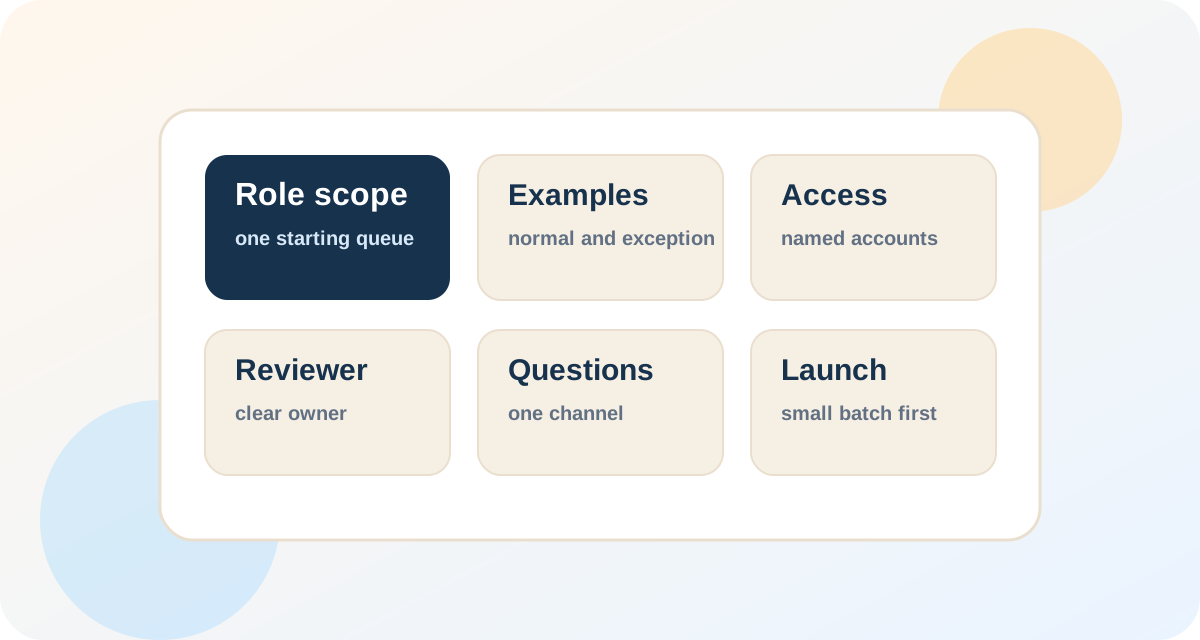
A handoff should preserve customer context, promises, ownership, and deadlines without duplicating replies.
Short answer
Use a bounded preparation lane with authoritative sources, limited access, explicit stop rules, a named client owner, and evidence that the final state was verified.
What to settle first
- Fix one cutoff and reference timezone for the outgoing and incoming support shifts.
- Inventory open cases, recent customer contact, promised actions, deadlines, risk flags, and current owner.
- Distinguish information prepared by the assistant from policy, remedy, account, or financial decisions.
- Record the last verified source state and the next permitted action rather than copying an entire message history.
Customer support checkpoint 1
fix one cutoff and reference timezone for the outgoing and incoming support shifts. For reconcile a customer-support shift handoff across time zones, the coordinator records what was observed and leaves interpretation or consequential approval with the named client owner. A second authorized reviewer should reproduce the handoff without unrelated private material.
Define the lane before granting access. Name its entry trigger, authoritative sources, permitted actions, stop conditions, decision owner, response clock, and evidence required for closure. A request to handle the work is not a boundary when it can affect identity, privacy, money, employment, customer promises, or system access.
Test checkpoint 1 with a clean case, a missing source, a contradictory record, and a time-critical exception. Preserve the first response, compare it with the expected route, and record whether the role stopped safely. Repeat after correction with a fresh case rather than treating coached familiarity as independent evidence.
Document what the coordinator may prepare, what the client owner must decide, and what evidence proves the destination state for checkpoint 1. Include the timezone, source version, access boundary, exception reason, response deadline, and fallback owner. Review the first ordinary case and every high-consequence exception, then update the written rule only through the named process owner.
Customer support checkpoint 2
inventory open cases, recent customer contact, promised actions, deadlines, risk flags, and current owner. For reconcile a customer-support shift handoff across time zones, the coordinator records what was observed and leaves interpretation or consequential approval with the named client owner. A second authorized reviewer should reproduce the handoff without unrelated private material.
Separate source facts, Filipino staff preparation, client-owner decision, executed action, and verified outcome. Use a stable case identifier, explicit timezone, source version, exact unresolved question, named owner, due date, approval reference, and destination event. Preserve conflict rather than overwriting the inconvenient value.
Test checkpoint 2 with a clean case, a missing source, a contradictory record, and a time-critical exception. Preserve the first response, compare it with the expected route, and record whether the role stopped safely. Repeat after correction with a fresh case rather than treating coached familiarity as independent evidence.
Document what the coordinator may prepare, what the client owner must decide, and what evidence proves the destination state for checkpoint 2. Include the timezone, source version, access boundary, exception reason, response deadline, and fallback owner. Review the first ordinary case and every high-consequence exception, then update the written rule only through the named process owner.
Customer support checkpoint 3
distinguish information prepared by the assistant from policy, remedy, account, or financial decisions. For reconcile a customer-support shift handoff across time zones, the coordinator records what was observed and leaves interpretation or consequential approval with the named client owner. A second authorized reviewer should reproduce the handoff without unrelated private material.
Use named accounts, multifactor authentication, least privilege, approved transfer routes, and restricted views. Keep credentials, payment data, employee records, customer secrets, identity documents, and private communications in governed systems. A coordination record can carry a controlled reference without becoming a second sensitive database.
Test checkpoint 3 with a clean case, a missing source, a contradictory record, and a time-critical exception. Preserve the first response, compare it with the expected route, and record whether the role stopped safely. Repeat after correction with a fresh case rather than treating coached familiarity as independent evidence.
Document what the coordinator may prepare, what the client owner must decide, and what evidence proves the destination state for checkpoint 3. Include the timezone, source version, access boundary, exception reason, response deadline, and fallback owner. Review the first ordinary case and every high-consequence exception, then update the written rule only through the named process owner.
Customer support checkpoint 4
record the last verified source state and the next permitted action rather than copying an entire message history. For reconcile a customer-support shift handoff across time zones, the coordinator records what was observed and leaves interpretation or consequential approval with the named client owner. A second authorized reviewer should reproduce the handoff without unrelated private material.
Define outcome codes before live work begins and reconcile opening items, additions, removals, transfers, completed cases, and ending cases. Review every consequential exception and a random sample of routine work. Activity volume and speed do not prove authority, accuracy, or useful closure.
Test checkpoint 4 with a clean case, a missing source, a contradictory record, and a time-critical exception. Preserve the first response, compare it with the expected route, and record whether the role stopped safely. Repeat after correction with a fresh case rather than treating coached familiarity as independent evidence.
Document what the coordinator may prepare, what the client owner must decide, and what evidence proves the destination state for checkpoint 4. Include the timezone, source version, access boundary, exception reason, response deadline, and fallback owner. Review the first ordinary case and every high-consequence exception, then update the written rule only through the named process owner.
Customer support checkpoint 5
require the incoming worker to acknowledge exceptions and unresolved owner questions before the prior shift closes. For reconcile a customer-support shift handoff across time zones, the coordinator records what was observed and leaves interpretation or consequential approval with the named client owner. A second authorized reviewer should reproduce the handoff without unrelated private material.
At the review cadence, compare the request, source, staff note, owner instruction, destination state, and later outcome. Track unsupported conclusions, incorrect routing, excess access, missing evidence, stale instructions, owner delay, duplicate work, and reopened cases. Correct the process when errors share a cause.
Test checkpoint 5 with a clean case, a missing source, a contradictory record, and a time-critical exception. Preserve the first response, compare it with the expected route, and record whether the role stopped safely. Repeat after correction with a fresh case rather than treating coached familiarity as independent evidence.
Document what the coordinator may prepare, what the client owner must decide, and what evidence proves the destination state for checkpoint 5. Include the timezone, source version, access boundary, exception reason, response deadline, and fallback owner. Review the first ordinary case and every high-consequence exception, then update the written rule only through the named process owner.
Customer support checkpoint 6
sample transferred cases for duplicate replies, missed promises, stale status, privacy exposure, and wrong ownership. For reconcile a customer-support shift handoff across time zones, the coordinator records what was observed and leaves interpretation or consequential approval with the named client owner. A second authorized reviewer should reproduce the handoff without unrelated private material.
Define the lane before granting access. Name its entry trigger, authoritative sources, permitted actions, stop conditions, decision owner, response clock, and evidence required for closure. A request to handle the work is not a boundary when it can affect identity, privacy, money, employment, customer promises, or system access.
Test checkpoint 6 with a clean case, a missing source, a contradictory record, and a time-critical exception. Preserve the first response, compare it with the expected route, and record whether the role stopped safely. Repeat after correction with a fresh case rather than treating coached familiarity as independent evidence.
Document what the coordinator may prepare, what the client owner must decide, and what evidence proves the destination state for checkpoint 6. Include the timezone, source version, access boundary, exception reason, response deadline, and fallback owner. Review the first ordinary case and every high-consequence exception, then update the written rule only through the named process owner.
Customer support checkpoint 7
Authoritative orientation includes the National Privacy Commission Data Privacy Act page at https://privacy.gov.ph/data-privacy-act/ and the Official Gazette text of Republic Act No. 10173 at https://www.officialgazette.gov.ph/2012/08/15/republic-act-no-10173/. Current client policy, contract terms, sector rules, and platform documentation still control the actual workflow.