

Philippines hiring guide
How to plan Filipino product return inspection records support
Organize condition evidence and return records without deciding refunds, warranty coverage, or inventory disposition.
Short answer
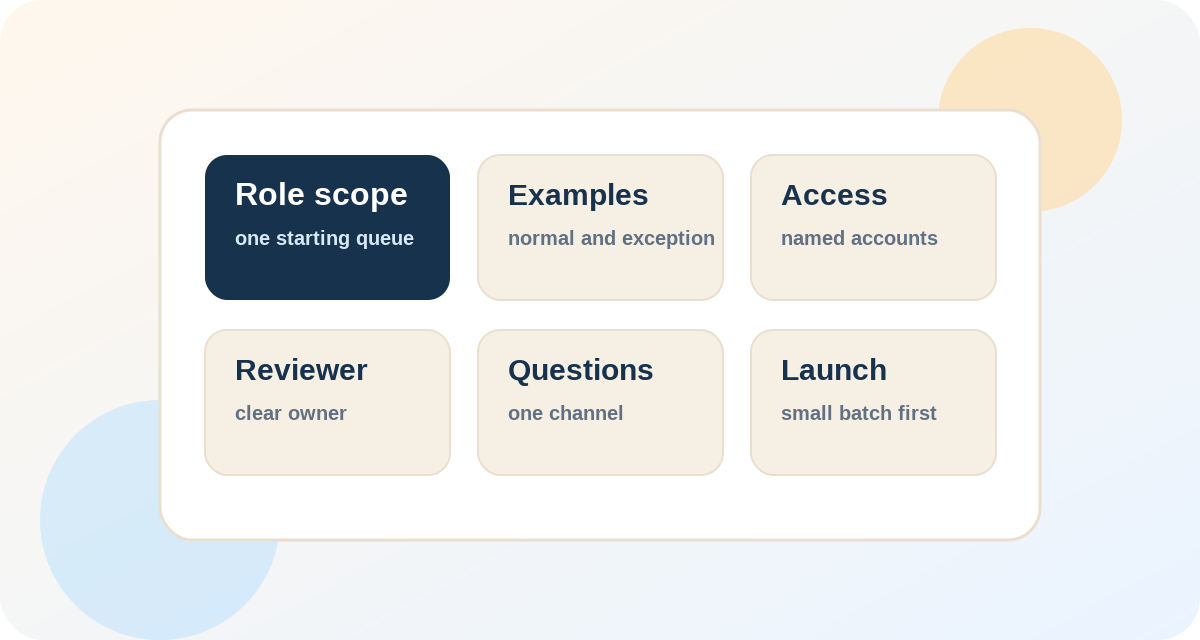
Scope product return inspection records around a finite evidence queue, named access, tested exceptions, and a returns or quality manager who keeps consequential decisions.
What to settle first
- Define the inputs and finish point for product return inspection records.
- Preserve source evidence and disagreements.
- Keep whether the return qualifies, who caused damage, what remedy applies, and how the item is dispositioned with the returns or quality manager.
- Expand only after sampled work is reproducible.
Define the record before assigning the queue
For product return inspection records, write the intake rule around the return authorization, item identifier, customer statement, received timestamp, condition photos, inspection checklist, and shipment record. The record should preserve the source location and time checked so the reviewer can reproduce the preparation.
A complete intake is not an approved outcome. Name the returns or quality manager beside the fields that require judgment, and keep missing evidence visible rather than filling gaps from memory.
Build a traceable evidence packet
The useful packet contains unaltered photographs, carrier events, serial or lot details, checklist version, and reviewer notes. Preserve original wording when a paraphrase could change the meaning.
When two sources disagree, show both values, their timestamps, and one precise question for the returns or quality manager. The coordinator should not choose the value that makes the queue easier to close.
Practice the difficult case
Test the workflow with this exception: the received serial number does not match the return authorization. The example should say what the worker records, what action pauses, and who receives the handoff.
Also test an ordinary item and an incomplete item. Those three samples reveal whether the procedure explains the real work or merely describes an ideal case.
Control access and continuity
Grant named access only to systems needed for product return inspection records. Record purpose, permission level, approver, review date, and the same-day removal step. Avoid shared credentials and uncontrolled exports.
Across Philippine and client working hours, the handoff should state the last verified event, unresolved question, next owner, and approved substitute path. Silence is not approval.
Review and measure the lane honestly
Sample source records, not only the final tracker. Classify corrections as missing evidence, transcription error, stale source, source conflict, weak instruction, or judgment outside the role.
Track returns logged, evidence gaps, identifier conflicts, inspection returns, and owner decisions outstanding. These are workflow signals, not guarantees of accuracy, savings, compliance, safety, satisfaction, revenue, or another business outcome.
Questions buyers ask
Q: What can the coordinator complete?
A: The coordinator can prepare and route the defined evidence packet using approved systems and examples.
Q: Who owns exceptions?
A: The returns or quality manager owns consequential decisions and any expansion of scope.
Q: What should the first review sample?
A: Review an ordinary item, an incomplete item, and the documented stop case.