
Philippines hiring guide
Is Your Management Team Ready to Outsource to the Philippines?
Test owner capacity, response coverage, instructions, and review time before opening an outsourced role.
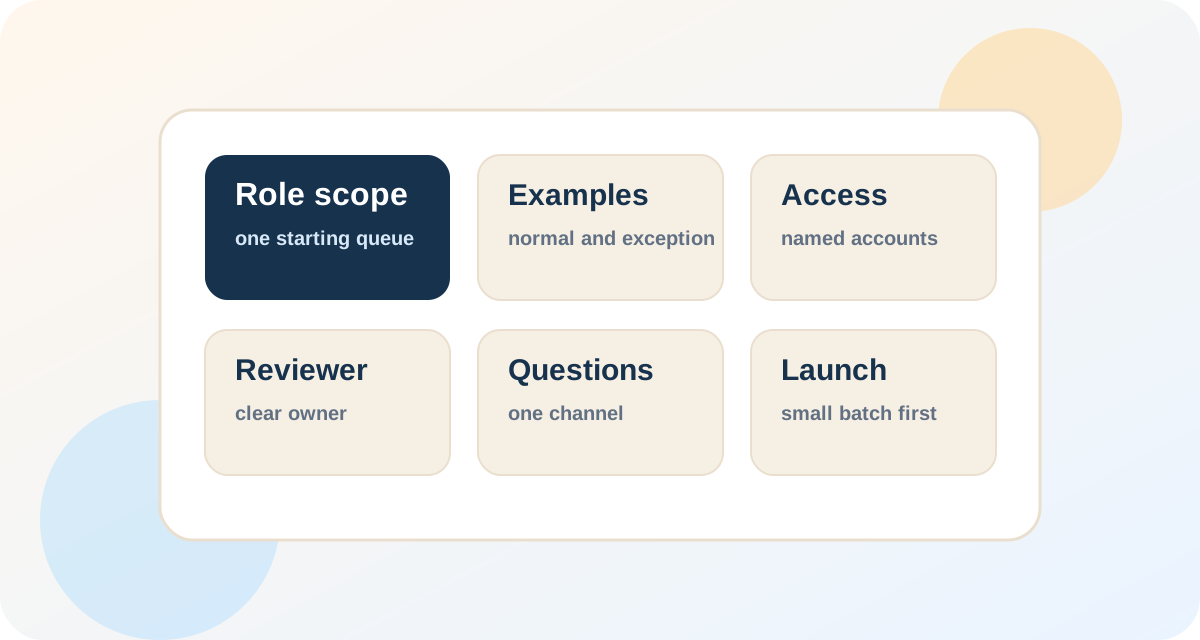
A role can be attractive on paper and still be unready for a handoff. This test focuses on the work the client must continue doing after a Filipino team member joins.
Short answer
A management team is ready when it can name the first queue, provide current examples, answer consequential questions, review early work, and remove obstacles on a predictable schedule. Outsourcing does not remove those duties. It changes where they appear. If no one owns them, start with a narrower queue or wait until an owner has capacity.
What to settle first
- Test the client team as carefully as the proposed outsourced role.
- Reserve real calendar time for questions, samples, and decisions.
- Use one live queue to expose missing ownership before expanding.
- Treat a narrow or delayed launch as a valid management decision.
Begin with the work that stays on the client side
A management-readiness test begins with retained work, not a wish list for the new hire. Choose one recurring queue and trace the decisions that surround it. A customer-support queue may contain routine status replies, but the client still owns policy, refund authority, account-security decisions, source-system corrections, and unusual customer promises. A bookkeeping-support lane may prepare records while the client or qualified adviser retains classification judgments, payment approval, bank control, and final review. Write those retained duties beside the delegated steps. If the retained column has no named person, the queue is not ready simply because its routine portion is well documented.
This distinction protects both delivery and the Filipino team member. Without it, ordinary questions travel through private chat until someone guesses, waits indefinitely, or accepts authority that was never intended. A useful readiness record names the accountable owner, a competent backup, the evidence each decision requires, and the safe state while an answer is pending. The worker can then assemble facts and continue reversible work without turning silence into permission. The management test is whether the client can operate that record under normal pressure, not whether leaders agree with it during a planning meeting.
Measure calendar capacity instead of managerial enthusiasm
Managers often support an outsourcing plan in principle while their calendars show no room to launch it. Estimate the recurring client work for the first month: instruction walkthroughs, access approvals, daily questions, sample review, corrections, exception decisions, and a weekly scope check. Put those blocks on the actual calendars of the primary and backup owners. A promise to be available is weaker than a protected thirty-minute review window with a defined input. If every block competes with an existing critical meeting, reduce the first queue until the review commitment becomes credible.
Consider a founder who wants to delegate six hours of weekly order follow-up. The queue may save attention later, but the first two weeks require the founder to settle conflicting examples, approve message limits, review a sample, and answer cases that could change a customer commitment. If the founder has no backup and travels for three days, the correct plan is not to assume the new worker will improvise. The business can exclude consequential cases, appoint and brief another owner, or delay the live batch. Calendar capacity is part of the role design because unanswered decisions create backlog even when the delegated work is performed well.
Run an instruction retrieval test
Readiness depends on whether a worker can retrieve the current rule at the moment of work. Select three recent cases: one routine, one incomplete, and one consequential. Ask a manager who did not write the procedure to find the governing source and explain the next action. The routine case should reach a clear finish. The incomplete case should preserve the gap and route it without invented data. The consequential case should stop at a named approval boundary. If the manager needs private message history or personal memory to answer, the instruction set is not ready for a remote handoff.
Repair the smallest useful part rather than writing a giant manual. Record the queue entrance, authoritative system or document, required fields, common reason codes, finish point, exclusion rules, and escalation owner. Add dated examples only when they illustrate those rules. An example that contradicts the current source should be retired, not left for the worker to reconcile. This retrieval test is deliberately different from asking whether documentation exists. A folder can contain hundreds of pages and still fail if nobody can identify which page governs today’s request.
Observe the first batch as a management exercise
Use a small live batch to measure both sides of the operating system. Track when each item arrived, which instruction applied, whether access worked, what question arose, who owned the answer, how long the item waited, and what evidence closed it. Review a mix of completed, returned, paused, and escalated cases. Looking only at easy completions hides the exact management work the test is meant to reveal. The batch is successful when its paths can be explained from evidence, not when every item moves quickly.
Separate execution defects from design defects. A missed documented field may require coaching or a clearer checklist. Two managers giving different answers is an ownership or policy problem. A system role that exposes refund controls for a status-only task is an access-design problem. A case waiting two days for approval is not proof that the worker is slow. Classifying the cause directs the correction to the right owner and prevents the business from turning all launch friction into a performance judgment about the Filipino team member.
Choose go, narrow, or wait from recorded evidence
Close the readiness test with one of three decisions. Go means the queue, instructions, access, owners, review capacity, and stop rules worked on representative cases. Narrow means a smaller subset can proceed while excluded categories remain with the client. Wait means a missing owner, unstable rule, unavailable system control, or absent review capacity would make live work unsafe or misleading. Record the evidence, decision maker, effective date, unresolved conditions, and next review. A wait decision is useful when it prevents an avoidable failed launch.
Do not turn the decision into a general claim that the company is or is not ready to outsource. Readiness belongs to a defined queue under current conditions. The same business may be ready for meeting-note preparation and unready for customer remedies. It may be ready during a stable month and need a new review after a system migration or policy change. This case-level conclusion gives a buyer a practical next action and gives a staffing conversation honest boundaries. The services overview can help compare potential lanes, while a planning request can focus on the one queue whose management duties are understood.